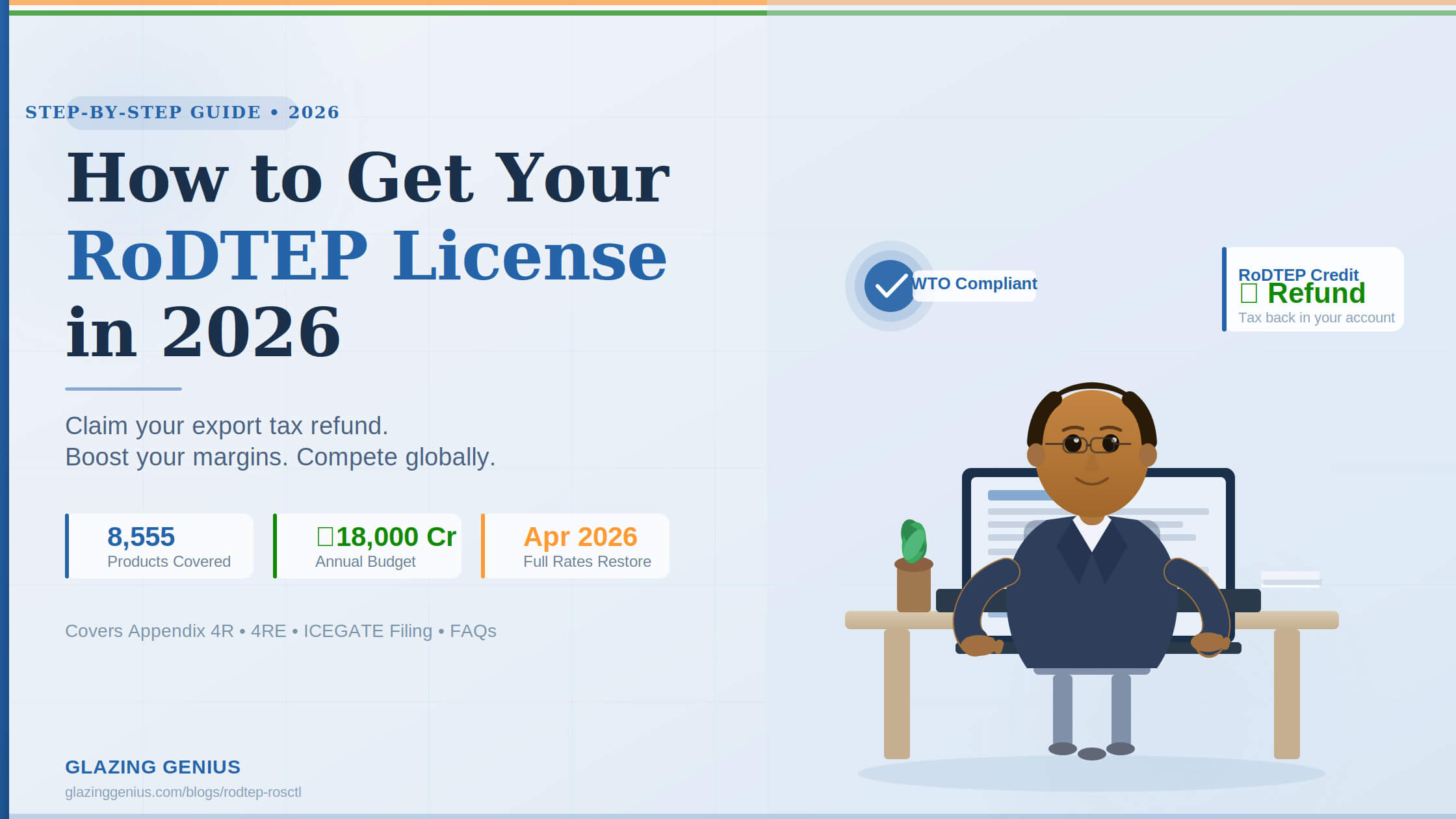
How to Get RoDTEP License in 2026
You work hard to manufacture and export your goods. But hidden taxes eat into your margins every single day. Mandi fees, electricity duty, fuel surcharges, none of these come back to you under GST. That money just disappears.
The RoDTEP scheme changes that. It puts that money back in your pocket as a transferable digital credit. And in 2026, with full rates set to restore from April 1, now is the best time to understand exactly how to claim it.
This guide breaks everything down, from what RoDTEP actually is, to the step-by-step process of claiming your benefit on ICEGATE.
What Is RoDTEP?
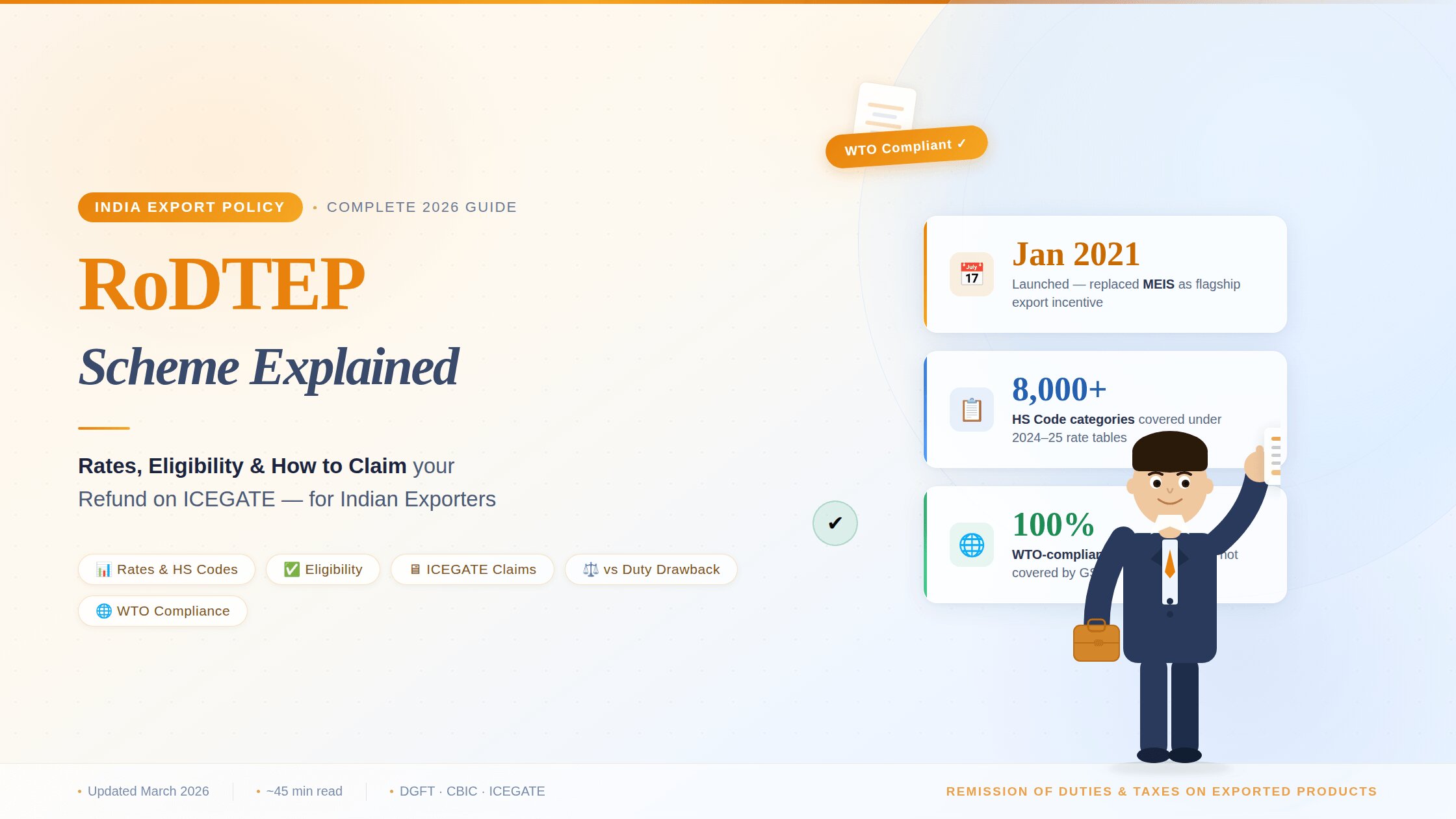
RoDTEP stands for Remission of Duties and Taxes on Exported Products. The Government of India launched it on January 1, 2021.
In simple terms, the scheme refunds taxes you paid during manufacturing and distribution, taxes that are embedded in your product cost but are not recoverable through GST or any other channel.
Think of it this way: you paid electricity duty to run your factory, fuel tax on your transport, and mandi charges on raw materials. RoDTEP refunds all of that.
Why Did India Create RoDTEP?
The USA filed a complaint against India at the World Trade Organization (WTO). The complaint was about India’s earlier export incentive scheme — MEIS (Merchandise Exports from India Scheme). The WTO ruled that MEIS gave Indian exporters an unfair advantage.
India had to replace MEIS with a WTO-compliant alternative. That alternative is RoDTEP. Instead of subsidizing exports, RoDTEP simply refunds taxes already paid which is a key distinction that satisfies WTO rules.
What Are the Needs for the RoDTEP Scheme?
Several real problems made the RoDTEP scheme necessary for Indian exporters:
- Indian goods carry embedded taxes that competitors from other countries do not pay. This makes Indian exports more expensive globally.
- The earlier MEIS scheme was declared non-compliant by the WTO. India needed a legally sound replacement.
- Taxes like electricity duty, mandi charges, and fuel cess are not covered under GST. Exporters had no way to recover them.
- India’s export competitiveness was weakening against countries like China, Vietnam, and Bangladesh.
- MSME exporters with thin margins of 5%–12% felt the impact most. Even small embedded taxes made pricing difficult.
RoDTEP directly addresses all of these problems. It levels the playing field so Indian exporters can compete confidently in global markets.
What Are the Features of the RoDTEP Scheme?
Here is what makes RoDTEP different from any previous export incentive scheme:
1. Fully WTO-Compliant
Unlike MEIS, RoDTEP only refunds taxes already paid. It does not offer additional subsidies. This makes it legally sound under international trade rules.
2. Covers All Sectors
RoDTEP applies across sectors — textiles, engineering goods, agriculture, marine, auto components, and more. All sectors have access to benefits under Appendix 4R (for DTA units) and 4RE (for SEZ/EOU/AA units).
3. Digital Credit Scrips on ICEGATE
You receive benefits as transferable electronic scrips on the ICEGATE portal. You can use these scrips to pay Basic Customs Duty or transfer them to another importer.
4. Covers 8,555 Tariff Items
RoDTEP benefits apply to 8,555 tariff lines at the 8-digit HS code level. You get a rate specific to your product — not a flat rate for everyone.
5. IT-Based Risk Management
ICEGATE uses an automated risk management system to verify records. This speeds up processing and reduces manual errors.
6. Both Manufacturer and Merchant Exporters Eligible
You qualify whether you manufacture goods yourself or trade as a merchant exporter. No minimum turnover is required.
7. Annual Budget of ₹15,000–₹18,000 Crore
The government allocates a significant annual budget to RoDTEP. This shows the scheme’s long-term commitment to supporting Indian exports.
Who Is Eligible for the RoDTEP Scheme?
You need to meet these conditions to claim RoDTEP benefits:
| ✅ Eligibility Checklist Run through this before your next shipment to confirm you qualify for RoDTEP benefits. |
- You must have a valid IEC (Importer-Exporter Code).
- Your exported product must be of Indian origin. Re-exported goods do not qualify.
- You must select the RoDTEP option in your shipping bill at the time of filing.
- Your product’s HS code must be listed under Appendix 4R or 4RE.
- You can be a manufacturer exporter or a merchant exporter.
- E-commerce exports via courier also qualify, provided the shipment physically leaves India from an EDI port and the airway bill is in your name.
- DTA exporters use Appendix 4R. SEZ, EOU, and Advance Authorisation holders use Appendix 4RE.
Who Does Not Qualify?
- Exporters of re-exported goods (goods not manufactured in India).
- Products not listed in the RoDTEP Appendix 4R or 4RE.
- Certain sectors like steel and pharmaceuticals have limited or no coverage.
How to Avail RoDTEP Scheme Benefits? (Step-by-Step)
Follow these steps carefully. Missing any one of them can delay or cancel your credit.
Step 1: Check Your HS Code
Log into the DGFT portal at dgft.gov.in and navigate to the RoDTEP section. Look up your product’s 8-digit HS code under Appendix 4R or 4RE. Confirm the applicable rate and any value cap for your item.
Step 2: Declare RoDTEP in Your Shipping Bill
When you file your shipping bill, select ‘RODTEPY’ in the INFO CODE field to indicate you are claiming the benefit. If you do not want to claim, enter ‘RODTEPN’. This declaration is mandatory and cannot be added after filing.
Step 3: File the Export General Manifest (EGM)
After your shipment departs, file the EGM. Once EGM is filed, Customs processes your RoDTEP claim automatically.
Step 4: Create Your eScrip Account on ICEGATE
Log into icegate.gov.in with your IEC credentials. Navigate to the RoDTEP module. Select your scheme — RoDTEP (Appendix 4R) or RoDTEP for SEZ/EOU/AA (Appendix 4RE). Click ‘Create eScrip Account.’ Your Credit Ledger account will activate immediately.
Step 5: View Your Credit Scroll
After Customs processes your shipping bill, a scroll is generated with the admissible RoDTEP amount for each shipment. You can view this in your ICEGATE account under your Credit Ledger.
Step 6: Generate and Use Your Credit Scrip
From your Credit Ledger, select the scroll entries you want to convert into a credit scrip. Generate the scrip. You can then:
- Use the scrip to pay Basic Customs Duty on your imports.
- Transfer the scrip to another importer for cash.
- Save it for future customs duty payments.
What Are the Rates Under the RoDTEP Scheme?
RoDTEP does not offer a single flat rate. Your rate depends entirely on your product’s HS code and the sector you export from.
Here is a general overview of how rates work:
- Rates are expressed as a percentage of the FOB (Free On Board) value of exports.
- Some products have a fixed rebate per unit of measurement instead of a percentage.
- Value caps apply in certain product categories (e.g., ₹1 to ₹100+ per unit).
- All rates are listed in Appendix 4R (for DTA exporters) and Appendix 4RE (for SEZ/EOU/AA exporters).
Rates Under RoDTEP — Appendix 4R and 4RE Explained
The RoDTEP rate table is published by DGFT. Here is a simplified sector-wise snapshot for 2026:
| Sector | RoDTEP Rate (% of FOB) | Notes |
| Agricultural & Food Products (HS Ch 1–24) | 0.5% – 4.3% | Full rates maintained (exempt from Feb 2026 cut) |
| Textiles & Apparel | 0.3% – 1.5% | Reduced by 50% (Feb 2026 notification) |
| Engineering Goods | 0.3% – 2.0% | Reduced by 50% |
| Marine Products | 1.0% – 3.0% | Varies by product |
| Auto Components | 0.3% – 1.5% | Reduced by 50% |
| Pharma & Chemicals | Previously excluded — limited coverage | Partial inclusion only |
To find your exact rate, visit dgft.gov.in and search your product’s 8-digit HS code under the RoDTEP section.
What Is the Difference Between Appendix 4R and 4RE?
| Appendix 4R | Appendix 4RE | |
| Who uses it? | DTA (Domestic Tariff Area) exporters | SEZ, EOU, and Advance Authorisation holders |
| Portal | ICEGATE | ICEGATE |
| Rate range | 0.3% – 4.3% of FOB | 0.3% – 4.3% of FOB (as notified) |
How to Maximize Your Export Earnings with RoDTEP?
Getting the credit is just the start. Here is how you can squeeze more value out of every RoDTEP scrip:
1. Verify Your HS Code Regularly
DGFT periodically updates the RoDTEP rate list. A wrong or outdated HS code means you either miss out on benefits or get a lower rate than you deserve. Check rates before every major export cycle.
2. Declare RoDTEP on Every Eligible Shipping Bill
Missing the RoDTEP declaration in a shipping bill means you lose that credit permanently. Train your documentation team to select ‘RODTEPY’ without fail.
3. Use eBRC-Compliant Payment Channels
Your eBRC must be generated on time for Customs to process your RoDTEP claim. Use RBI-approved remittance channels and ensure your bank links payments to the correct export document.
4. Transfer Scrips for Instant Cash
If you do not import enough to use your scrips, sell them to other importers. The scrip market is active, and you can convert your credits to cash quickly.
5. Monitor the ICEGATE Ledger Weekly
Log into ICEGATE regularly and check your Credit Ledger. Unprocessed scrolls or pending scrips cost you time and money. Catch issues early and resolve them before they pile up.
6. Plan for Full Rate Restoration from April 2026
The government confirmed that full RoDTEP rates return from April 1, 2026. If you are pricing contracts for Q2 onwards, factor in the higher benefit rates in your costing and pricing models.
Frequently Asked Questions (FAQs)
Related Posts:
DGFT IEC Registration: Step-by-Step Guide for New Exporters
RoDTEP Scheme Explained: Understand How to Claim Your Refund in 2026