

How to Register Your Company in India (Your Simple 2026 Guide)
Picture yourself six months from now.
You’re holding your first corporate contract. Your business account has actual revenue flowing in. Investors are taking you seriously. And it all started because you took one crucial step today.
Right now, you might feel overwhelmed. The paperwork seems endless. The legal terms sound like a foreign language. And you’re wondering if you can actually do this yourself.
Here’s the truth: Thousands of entrepreneurs just like you register companies in India every single month. Most of them had zero legal background. They simply followed a clear roadmap.
That’s exactly what you’re getting today.
This guide walks you through every single step of company registration in India. No confusing jargon. No shortcuts that land you in trouble. Just the real process that works in 2026.
By the time you finish reading, you’ll know exactly what to do. You’ll understand which documents to gather. You’ll see how much it really costs. And you’ll stop feeling scared about the whole thing.
Your entrepreneurial journey starts here. Let’s make it official.
Why You Actually Need to Register Your Company
Let’s be honest. Registration feels like unnecessary paperwork when you could be building your product instead.
But here’s what happens when you skip it.
Your personal savings become your business risk. Without registration, there’s no separation between you and your business. If something goes wrong, creditors can come after your house. Your car. Your personal bank account. Everything you own is fair game.
Banks won’t give you serious money. Try walking into a bank and asking for a business loan without registration. They’ll smile politely and show you the door. Investors? They won’t even return your calls.
Big clients won’t trust you. That corporate contract you want? Most companies only work with registered businesses. Government tenders? Forget about it without proper registration.
Now imagine the flip side.
You register your company today. Suddenly, you’re a real business entity. Your personal assets stay protected. Banks start conversations about loans. Investors actually read your pitch deck. And you sleep better knowing you’re legally covered.
Plus, you get tax benefits that sole proprietors can only dream about.
Registration isn’t just paperwork. It’s your shield, your credibility, and your ticket to playing in the big leagues.
Let’s get you there.
Which Type of Company Should You Register?
This decision matters more than you think. Pick the wrong structure and you’ll waste money on unnecessary compliance. Pick the right one and everything flows smoothly.
Let us break down your options:
Private Limited Company
Think of this as the BMW of business structures. It’s what most serious entrepreneurs choose.
Here’s what you get: – Your personal money stays separate from business money – You can bring in investors without messy negotiations – Your com- pany exists independently (even if something happens to you) – Banks take you seriously from day one
What you need: – At least 2 people to be directors – At least 2 shareholders (yes, the same people can wear both hats) – One director must live in India
Best for you if: You’re building a startup that needs funding. You want to scale big. You’re serious about creating something that lasts beyond you.
The catch: More compliance work than other options. You’ll need quarterly board meetings and annual filings. But most entrepreneurs say it’s worth it.
Limited Liability Partnership
This is like a partnership on steroids. You get the flexibility of a partnership with the protection of a company.
Here’s what you get: – Partners have limited liability (your house is safe) – Less paperwork than Private Limited – Lower compliance costs – More operational flexibility
What you need: – Minimum 2 partners – At least one must be an Indian resident – No limit on maximum partners
Best for you if: You’re a CA, lawyer, or consultant. You’re running a family business. You want protection without heavy compliance. You’re not chasing venture capital right now.
The catch: Harder to raise outside funding. Investors prefer Private Limited companies.
One Person Company
This one’s perfect if you’re a one-person show who wants real company status.
Here’s what you get: – All benefits of a Private Limited Company – You’re the only owner – Limited liability protection – Less compliance than Private Limited
What you need: – Just you as the single director and shareholder – One nominee (someone who takes over if something happens to you)
Best for you if: You’re testing a business idea solo. You want protection but don’t have co-founders yet. You’re a freelancer ready to formalize.
The catch: If your company grows past 50 lakhs capital or 2 crore revenue, you must convert to Private Limited.
Public Limited Company
This is for companies planning to go public and list on stock exchanges.
What you need: – Minimum 3 directors – Minimum 7 shareholders – Serious capital investment
Best for you if: You’re already established and planning an IPO. You need massive public funding. You’re ready for intense regulatory scrutiny.
The reality: Most startups should ignore this option. It’s overkill unless you’re thinking really, really big.
Partnership Firm
Two or more people sharing profits based on an agreement.
The problem: No limited liability. Your personal assets are at risk. Hard to scale. Difficult to raise funding.
Skip this if: You want to build anything beyond a small local business.
Sole Proprietorship
You and your business are legally the same person.
The danger: Zero protection for personal assets. No credibility with serious clients. Can’t raise funding.
Only choose this if: You’re running a tiny side hustle and never plan to grow it.
Understanding MCA Registration (In Simple Terms)
The Ministry of Corporate Affairs (MCA) is like the government’s company registry office. Every legitimate company in India must register here.
Think of it as getting your business its birth certificate. When you register with MCA, you get:
Your Certificate of Incorporation – This is your company’s official birth certificate. It proves your company legally exists.
A Corporate Identification Number (CIN) – This is like your company’s Aadhaar card. It’s a unique 21-digit number that identifies your business.
PAN and TAN – Your company’s tax identity cards. You need these to file taxes and deduct TDS.
The good news? The whole process happens online through the MCA portal.
The even better news? There’s a single form called SPICe+ that handles every- thing at once. You don’t fill out fifteen different forms anymore.
Here’s what SPICe+ does for you: – Reserves your company name – Registers your company – Gets you PAN and TAN automatically – Registers you for employee benefits (if needed) – Sets up your GST registration (if you want)
One form. One submission. Done.
This is why company registration in 2026 is dramatically easier than it was even five years ago.
What You Need Before Starting Company Registration
Let’s gather everything upfront. Nothing’s worse than starting the application and realizing you’re missing a document.
The People You Need
For Private Limited Company: You need at least 2 directors and 2 share- holders. The same people can be both. So you and your co-founder can be the two directors and the two shareholders.
One of you must be an Indian resident. The other can be anyone from anywhere in the world.
For LLP: You need 2 partners minimum. At least one must live in India.
For OPC: Just you. Plus one nominee (a backup person who takes over if something happens to you).
The Address You Need
Your company needs a registered office. This is where government mail comes. Here’s the thing: It can be your home address. Seriously.
You don’t need a fancy commercial office. Your apartment works fine. So does a co-working space. Or your rented office.
You just need proof: – An electricity bill (less than 2 months old) – Or a water bill – Or property tax receipt – Plus a rent agreement if you’re renting – Plus a No Objection Certificate from the property owner.
The Money You Need
Good news: There’s no minimum capital requirement anymore.
You can start a Private Limited Company with 10,000 if you want. Or 1 lakh. Or 10 lakhs. Your choice.
Most people start with 1 lakh authorized capital because it sounds professional.
The Documents You Need
For each director (if you’re Indian): – PAN Card (mandatory) – Aadhaar Card – One recent passport-size photo – Voter ID or Driving License or Passport (any one) – A recent bank statement or utility bill (address proof) – Email address and mobile number
Foreign directors: – Valid passport (needs to be notarized) – Address proof from your home country (needs apostille certification) – Bank reference letter – Recent photograph
Your office: – Utility bill (electricity, water, or gas) less than 2 months old.
Rent agreement (if renting) – No Objection Certificate from property owner – Sale deed (if you own the property)
Gather all these documents before you start. Put them in one folder. You’ll thank yourself later.
Step-by-Step Guide on Company Registration in India
Alright. Documents ready? Let’s walk through this step-by-step guide to register a company in India in 2026.
Step 1: Get Your Digital Signature Certificate
Think of this as your electronic signature. You’ll use it to sign all official documents online.
Time needed: 2-3 days
Cost: 500 to 2,000 per person
Every director needs their own Digital Signature Certificate (DSC).
Here’s how you get it:
Visit a certified authority website like e-Mudhra or Sify. Choose “Class 3 DSC for company registration.” Upload your PAN, Aadhaar, and photo. Complete video verification if they ask. Pay the fee.
They’ll courier you a USB token with your digital signature within 2-3 days. Keep this safe. You’ll use it for every official filing from now on.
Step 2: Apply for Director Identification Number
Every director in every company in India needs a DIN. It’s like your director’s license.
Time needed: 1-2 days
Cost: Included in registration fees
The beautiful part? You apply for this while registering your company. No separate application needed.
You’ll fill a form called SPICe+ Part B. One section asks for director details. You’ll get your DIN automatically when your company gets approved.
One DIN lasts your entire life. You use the same DIN even if you become a director in 10 different companies.
Step 3: Reserve Your Company Name
This is the fun part. Naming your business.
Time needed: 1-3 days
Cost: 1,000
But there are rules.
Your name must end with “Private Limited” or “Pvt Ltd” for Private companies. So if you want “TechStar,” your official name becomes “TechStar Private Limited.”
Your name can’t be identical or too similar to existing companies. The government checks this carefully. “TechStar” and “TechStars” are too similar. They’ll reject one.
You can’t use certain words without permission. Words like “Bank,” “Insurance,” “Government,” or “National” need special approval.
Check if your name is available:
Go to the MCA portal. Click “Check Company Name Availability.” Type your desired name. The system shows you if similar names exist.
Pro tip: Prepare two name options. You’ll submit both in order of preference. If your first choice gets rejected, they automatically consider your second choice.
How to submit:
Log into the MCA portal. Fill SPICe+ Part A (name reservation form). Enter your two name choices. Pay 1,000. Wait 1-3 days.
Once approved, your name is reserved for 20 days. You must complete your full registration within this window.
Step 4: Draft Your MOA and AOA
Don’t let these acronyms scare you. They’re simpler than they sound.
MOA (Memorandum of Association) is like your company’s constitution. It tells the outside world what your company does.
AOA (Articles of Association) is like your company’s internal rulebook. It explains how you’ll run things internally.
What goes in your MOA: – Your company name – Your registered office address – What your company will do (business objectives) – How much capital you’re authorizing – Who the initial shareholders are
What goes in your AOA: – How you’ll issue and transfer shares – How you’ll appoint and remove directors – How you’ll conduct board meetings – How you’ll distribute dividends – How you’ll borrow money
The easy way:
The MCA portal provides standard templates. Most companies use these tem- plates and just fill in their specific details.
Your CA or company secretary can customize these if needed. But the standard versions work fine for most startups.
You’ll sign these documents using your Digital Signature Certificate.
Step 5: File Your SPICe+ Part B Application
This is where everything comes together.
Time needed: 5-7 days for approval
Cost: 500 to 10,000 (depends on your capital)
SPICe+ Part B is the master application that does everything at once.
Log into the MCA portal. Navigate to SPICe+ services. Click on Part B.
Fill in your details carefully: – Your approved company name – Your registered office address – Details of all directors and shareholders – How much capital you’re authorizing and actually paying up – What business activities you’ll do – Email and phone numbers
Upload your documents: – Proof of registered office – Identity proof of all directors – Address proof of all directors – Your digitally signed MOA and AOA
– Consent letters from each director – NOC from property owner (if office is rented)
Pay your fees. The cost depends on your authorized capital: – Up to 1 lakh: 500 – 1 lakh to 5 lakhs: 2,000 – 5 lakhs to 10 lakhs: 3,000 – 10 lakhs to 50
lakhs: 5,000 – Above 50 lakhs: 7,000
Plus stamp duty (varies by state, usually 0.2% to 0.7% of capital).
Submit everything. Double-check before hitting submit. Mistakes mean delays.
The Registrar of Companies (ROC) now reviews your application. They check if everything is correct and complete.
Step 6: File AGILE Form (Optional But Smart)
AGILE is an optional add-on that saves you time later.
It stands for Application for GST, EPFO, ESIC, and Bank Account. Basically, it helps you get all your business registrations done together.
Use AGILE if: – You need GST registration immediately – You’ll hire employ- ees from day one – You want to fast-track your bank account opening
Skip AGILE if: You’re starting small and can register for these things later when needed.
Step 7: Receive Your Certificate of Incorporation
This is your victory moment.
Time needed: 5-7 business days after filing
The ROC reviews everything. If they’re satisfied, they approve your application. You receive three important documents by email:
Certificate of Incorporation – Your company’s official birth certificate. It shows your company name, date of incorporation, and CIN (Corporate Identifi- cation Number).
PAN Card – Your company’s permanent account number for taxes. This comes to your registered office address by post.
TAN Certificate – Tax Deduction Account Number for TDS compliance. Your CIN looks something like this: U74999DL2026PTC412345
Breaking this down: – U means unlisted company – 74999 is your industry code – DL is your state (Delhi in this case) – 2026 is when you incorporated – PTC means Private Company Limited by shares – 412345 is your unique registration number
Save these documents. You’ll need them for opening bank accounts, filing taxes, and everything else.
Congratulations. Your company is now officially registered.
What You Must Do After Company Registration
Don’t celebrate too long. Registration is just the starting line.
You have important deadlines to meet. Missing them means penalties.
Within 30 Days of Registering a Company
Open your company bank account. You can’t use your personal account for business anymore.
Visit any bank. Carry your Certificate of Incorporation, MOA, AOA, and a board resolution authorizing account opening. Plus KYC documents for all directors.
Hold your first board meeting. Get all directors together (even if it’s just you and your co-founder sitting in a coffee shop).
In this meeting, you must: – Appoint your first auditor – Issue share certificates to initial shareholders – Confirm your registered office address – Appoint key officers (if any)
Document everything in meeting minutes. Sign them. Keep them safe.
Within 60 Days of Registering a Company
Register for GST if needed. You must register if your annual turnover will exceed 20 lakhs ( 10 lakhs in special category states).
You can also register voluntarily even if you’re below the threshold. Many businesses do this because it looks more professional.
Within 180 Days of Registering a Company
File your commencement of business declaration. This is form INC-20A.
It basically tells the government: “Yes, we’ve opened our bank account and we’re actually doing business now.”
This is mandatory. Don’t skip it.
Every Year After Registering a Company
Hold an Annual General Meeting (AGM). Must happen within 6 months of your financial year ending.
File your annual financial statements. Form AOC-4 must be filed within 30 days of your AGM.
File your annual return. Form MGT-7 must be filed within 60 days of your AGM.
File your income tax return. The due date is September 30 every year. Even if you made zero profit, you must file.
Conduct at least 4 board meetings spread throughout the year. The gap between meetings can’t exceed 120 days.
Mark these dates in your calendar. Set reminders. Never miss deadlines.
Common Mistakes To Avoid While Registering a New Company
Learn from others’ pain. Avoid these traps.
Mistake 1: Choosing the wrong structure because it’s cheaper
Yes, LLP has lower compliance costs than Private Limited. But if you need investor funding next year, you’ll regret it. Investors hate LLPs.
Choose based on your actual business needs, not just to save 5,000 on annual compliance.
Mistake 2: Picking a name without checking trademarks
You register “TechFlow Private Limited.” Everything’s great. Then six months later, someone sues you because “TechFlow” is their registered trademark.
Always check both MCA name availability AND trademark registry before finalizing your name.
Mistake 3: Using an old utility bill
The bill must be less than 2 months old. People submit 3-month-old bills. Application gets rejected. They waste 2 weeks.
Check your documents’ dates before submitting.
Mistake 4: Forgetting the property owner’s NOC
If you’re using a rented office or even your rented home, you need a No Objection Certificate from the owner.
People forget this. Application gets rejected. Scrambling to get the NOC delays everything.
Mistake 5: Ignoring post-incorporation compliance
People celebrate after getting their certificate. Then they forget to file INC-20A within 180 days.
Result? Penalties. Sometimes even company closure. Set up a compliance calendar from day one.
Mistake 6: Not maintaining statutory registers
By law, you must maintain registers of members, directors, and charges.
People treat this as optional. Then during an audit or inspection, they face penalties.
Start maintaining these from day one. It’s easier than backfilling later.
Mistake 7: Hiring the cheapest service provider
Someone offers to register your company for 3,000. Sounds great.
Then they make mistakes. Or they disappear when you have questions. Or they file incorrect information.
Fixing these mistakes costs you 10 times more than hiring a proper professional like Glazing Genius initially.
Choose quality over the lowest price.
What Company Registration Really Costs
Let’s talk about how much registering a company costs. No hidden surprises.
Government Fees (Unavoidable) Name reservation: 1,000
SPICe+ filing fee: 5,000 to 10,000 (based on your capital)
Stamp duty: Varies by state ( 1,000 to 5,000)
Digital signatures (for 2 directors): 1,500 to 3,000
Total government fees: 10,000 to 30,000
Professional Fees (If You Hire Help)
CA or company secretary: 5,000 to 15,000
Document preparation: 2,000 to 5,000
Consultation: 1,000 to 3,000
Total professional fees: 8,000 to 23,000
Optional Extras
Trademark registration: 4,000 to 10,000
Professional logo design: 2,000 to 20,000
Website and domain: 1,000 to 5,000
Your Total Investment
DIY route: 11,000 to 15,000 (if you do everything yourself) With professional help: 20,000 to 30,000 (most common) Premium package: 40,000 to 55,000 (everything included)
Most startups spend around 25,000 total for professional registration with all basics covered.
How Long Does Registering a Company Actually Take?
Here’s your realistic timeline.
Getting DSC: 2-3 days
Applying for DIN: 1-2 days
Name reservation: 1-3 days
Preparing documents: 1-2 days
Filing SPICe+: Same day
ROC processing: 5-7 days
Receiving certificate: Same day after approval
Total time: 10-17 days
Fastest possible: 7-10 days (if you have everything ready)
Average case: 12-15 days
If ROC raises queries: 20-30 days
The timeline depends on: – How complete your documents are – Which state you’re registering in (some ROCs work faster) – How complex your business objectives are – How busy the ROC is that week – Whether you made any mistakes in your application
Want to go faster? Have all documents ready before you start. Double-check everything before submitting. Respond to any ROC queries within 24 hours.
FAQs
2 Responses
Leave a Reply
Related Posts:

DGFT IEC Registration: Step-by-Step Guide for New Exporters
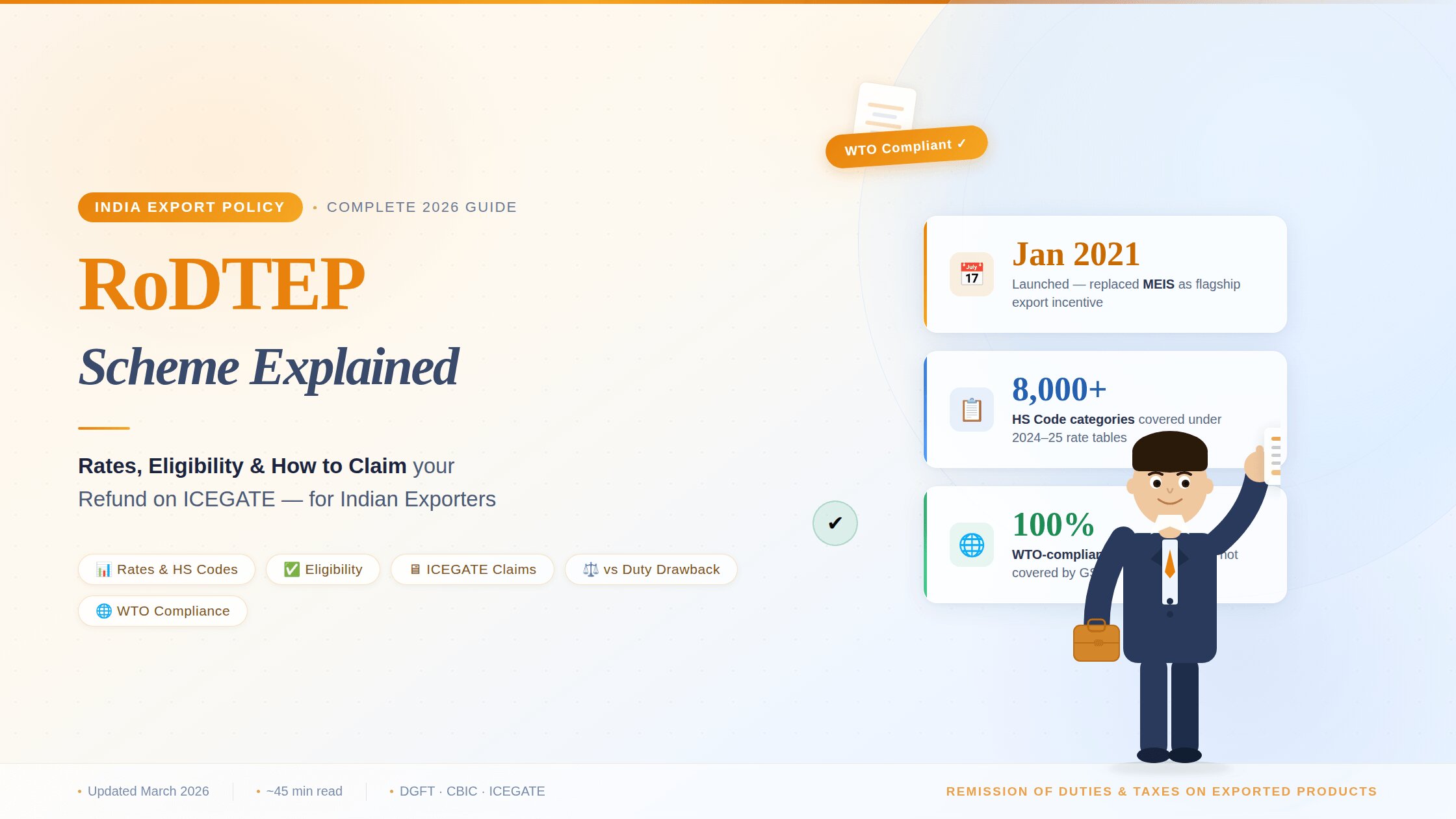
RoDTEP Scheme Explained: Understand How to Claim Your Refund in 2026

After research a few of the blog posts on your website now, and I really like your way of blogging. I bookmarked it to my bookmark website list and will likely be checking back soon. Pls take a look at my website as nicely and let me know what you think.
I’ve been surfing online more than three hours today, yet I never found any interesting article like yours. It’s pretty worth enough for me. In my opinion, if all website owners and bloggers made good content as you did, the net will be a lot more useful than ever before.