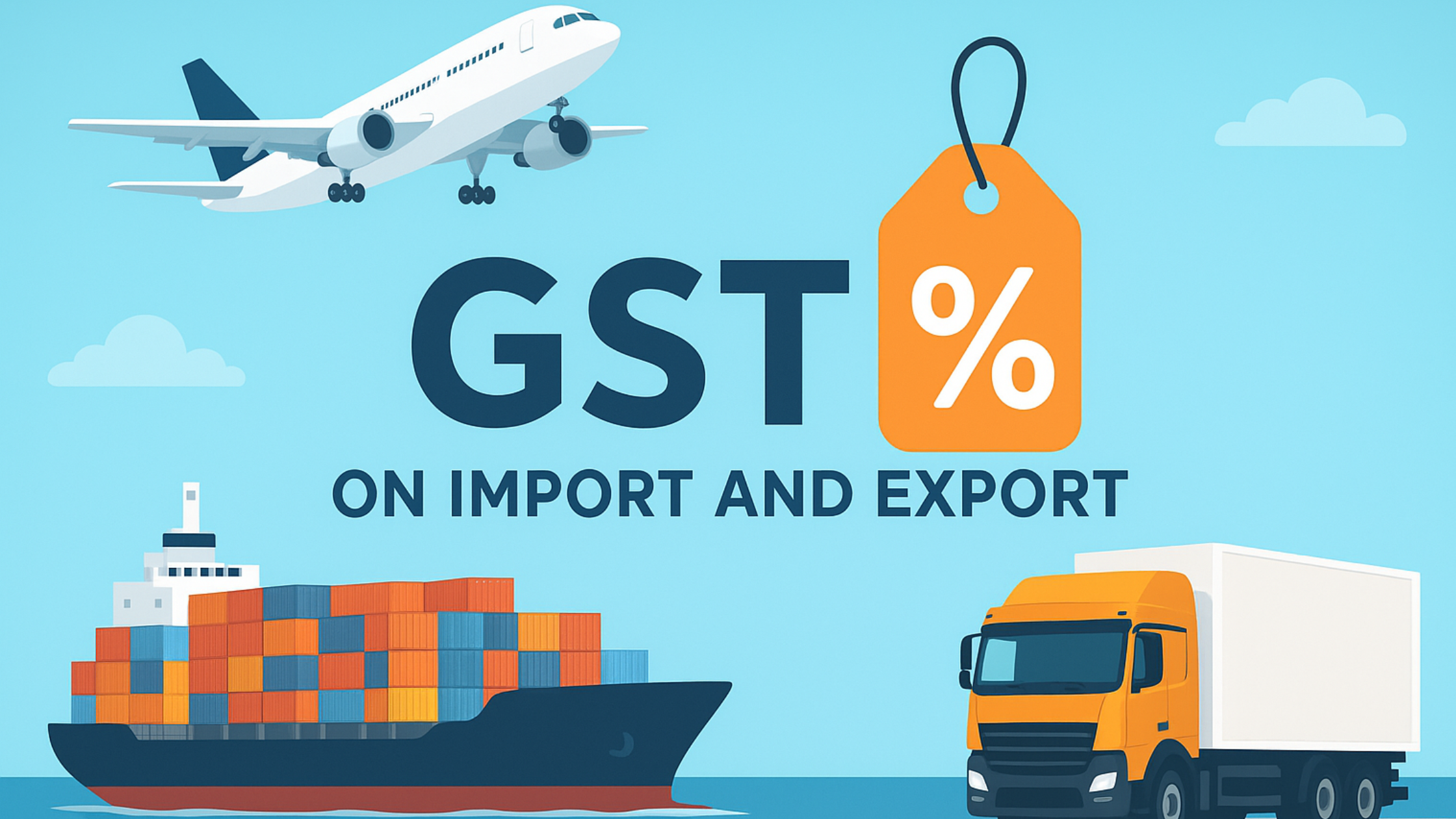
Understanding GST on Export & Import
The Goods and Services Tax (GST) has brought a unified tax framework for businesses engaged in international trade. Understanding GST on export and import is crucial for exporters and importers to manage compliance, refunds, and global competitiveness.
Under GST, exports are treated as zero-rated supply, meaning no GST is charged on export of goods under GST or export of services under GST. Exporters can either export without payment of IGST by furnishing an LUT under GST or pay IGST and later claim a GST refund on exports. This helps reduce tax blockage and improve cash flow. The eBRC and GST refund system ensures quick verification of export payments and transparency through DGFT–GST integration.
In the case of imports, GST on import of goods is levied as Integrated GST (IGST) along with customs duties. Registered businesses can claim it as Input Tax Credit (ITC), minimizing the import and export tax in India burden. Similarly, GST on import of services is applicable under the reverse charge mechanism, ensuring tax compliance on overseas services.
These measures promote fairness and streamline international trade. The conditions for export of goods under GST emphasize proper documentation, accurate invoicing, and compliance to claim benefits. By following GST compliance for exporters, businesses can enjoy smoother refunds and fewer disputes.
In short, exports under GST are considered as zero-rated, empowering Indian exporters while ensuring full compliance with GST implications on international trade.
Key Insights:
- Exports are zero-rated under GST, meaning no tax is ultimately borne by the exporter.
- Importers pay IGST, but can claim ITC for business purposes.
- RCM applies to import of services, ensuring fair taxation on cross-border supplies.
- eBRC and DGFT systems are digitally linked for GST refund verification.
- Timely filing of returns, LUT, and refund applications is essential to avoid compliance penalties.
Introduction to GST in International Trade
1.GST is and its role in exports and imports.
GST (Goods and Services Tax) is a unified tax system in India that simplifies trade. It ensures transparency, reduces cascading taxes, and regulates taxation on both exports and imports efficiently.
2.How GST simplifies indirect taxation and ensures transparency in cross-border trade.
GST simplifies indirect taxation by merging multiple taxes like excise, VAT, and service tax into one unified system. It ensures transparency in cross-border trade through standardized documentation, digital tracking, and seamless input tax credit, reducing tax evasion and promoting smoother compliance for exporters and importers alike.
Role of GST on Export of Goods and Services
GST treats the export of goods and services as zero-rated supplies, ensuring no GST burden on exporters. Whether for GST on export of services, B2C exports, or goods, the export GST rate remains zero, reducing export tax and export duty in India, and improving global competitiveness.
- Exports are treated as “Zero-Rated Supplies” Under GST:
Under GST, exports of goods and services are classified as zero-rated supplies, meaning the GST rate is 0%. Exporters do not have to pay GST on outward export supplies, and they can also claim refund of input tax credit (ITC) used in making those exports. This ensures that taxes do not become part of the export cost, making Indian products more competitive in global markets.
- The basic difference between-
Export with payment of IGST and Export without payment of IGST
| Basis of Difference | Export With Payment of IGST | Export Without Payment of IGST (Under LUT) |
| Meaning | Exporter pays IGST on goods/services at the time of export. | Exporter exports goods/services without paying IGST by filing an LUT. |
| Refund Type | Refund of IGST paid is claimed after export. | Refund of unutilized Input Tax Credit (ITC) is claimed. |
| Working Capital Impact | High impact — funds get temporarily blocked until refund is received. | No blockage — ideal for exporters wanting better cash flow. |
| Requirement | No LUT required; only IGST payment and documentation. | Mandatory Letter of Undertaking (LUT) filed yearly. |
| Refund Processing Time | Generally faster because it’s IGST refund based on shipping bill. | Slightly slower due to ITC verification. |
| Preferred By | Occasional exporters or those with low cash flow issues. | Regular exporters wanting smooth liquidity. |
| Compliance Level | More financial compliance due to IGST payment. | Less financial burden; only LUT compliance needed. |
| Practical Benefit | Ensures faster refund credit directly from Customs. | Helps exporters avoid upfront tax payments and maintain cash efficiency. |
GST on Import of Goods –
Key Points:
- Imported goods are treated as interstate supplies, attracting IGST in addition to Basic Customs Duty (BCD).
- The IGST paid on imports is eligible for Input Tax Credit (ITC) for registered businesses, helping reduce overall tax liability.
- The taxable value for GST is calculated based on CIF value (Cost + Insurance + Freight) plus applicable customs duties, ensuring accurate tax assessment.
GST on Import of Services –
Key Points:
- Import of services refers to services received from a foreign supplier by a person in India, and it becomes taxable when the place of supply is in India.
- Tax is paid under the Reverse Charge Mechanism (RCM), meaning the recipient (importer) must directly pay GST, not the foreign service provider.
- The GST paid under RCM is eligible for Input Tax Credit (ITC) for registered businesses, allowing them to offset their output tax liability.
Refund Process for Exporters under GST
Step-by-Step Guide to Claim GST Refund on Exports
1. Ensure Export Documents Are Ready
Prepare shipping bill, invoice, LUT (if exporting without IGST), eBRC, and export declarations.
2. File Export Invoice Details in GSTR-1
Upload all export invoices under Table 6A of GSTR-1 for refund processing.
3. Verify Shipping Bill & EDI System Matching
Ensure details in GST portal match Customs data (shipping bill number, date, port, value).
4. Choose Refund Type
- Export with payment of IGST: Refund auto-processed through shipping bill.
- Export without IGST (LUT): Apply refund for unutilized ITC.
5. File Refund Application on GST Portal
Submit Form GST RFD-01 with required documents like eBRC, invoice copy, LUT, declaration, and ITC details.
6. Upload Supporting Documents
Attach bank certificate, export invoices, and statements as per refund category.
7. ARN Generation & Acknowledgment
Once filed, an ARN (Application Reference Number) is generated for tracking.
8. Refund Processing by GST Officer
Officer verifies documents and eligibility.
9. Refund Sanction & Amount Credited
Approved refund is credited to the exporter’s bank account.
Common issues faced by exporters in refund claims.
Step-by-Step -Common issues exporters face in refund claims
1. Mismatch between GST and customs data
Problem: Shipping bill details (value, invoice number, port) don’t match the GST portal entries.
Fix: Reconcile invoices and shipping bills before filing; request customs or bank corrections immediately if mismatches occur.
2. Delayed eBRC / bank realization uploads
Problem: Bank delays in uploading eBRC prevent refund verification.
Fix: Submit remittance evidence to your bank, follow up proactively, and keep acknowledgement proofs to escalate if needed.
3. Incomplete or incorrect documentation
Problem: Missing invoices, LUT, packing lists, or improper declarations lead to rejections.
Fix: Use a pre-submission checklist; ensure every refund claim includes the exact document set required for that refund category.
4. Wrong claim category chosen
Problem: Filing refund under the wrong route (IGST refund vs. ITC refund) causes delays.
Fix: Confirm whether you exported with IGST or under LUT and choose the correct refund flow before filing.
5. Invoice timing and cut-off errors
Problem: Export invoice dates falling outside the eligible period or GST return period mismatch.
Fix: Validate invoice dates, GST return filings, and shipping bill dates when preparing the refund application.
6. ITC reconciliation gaps
Problem: Claimed Input Tax Credit does not reconcile with GSTR-2A/2B or supplier data.
Fix: Reconcile ITC monthly, resolve supplier filing issues, and adjust your claim to match available ITC records.
7. System/portal validation failures
Problem: Technical rejections due to format, file size, or portal validation rules.
Fix: Follow prescribed file formats, compress attachments within limits, and use supported browsers — upload early to avoid last-minute portal glitches.
8. Incorrect valuation or classification
Problem: Wrong HS code, CIF valuation, or customs classification leads to disputes.
Fix: Verify HSN/ITC-HS codes and valuation (CIF + duties) with customs broker before filing; correct proactively if mismatches found.
9. Lack of follow-up after filing
Problem: No tracking or response until audit notice—delays escalate.
Fix: Track ARN status, respond fast to GST officer queries, and maintain a single point of contact for follow-ups.
10. Fraud or compliance flags
Problem: Unusual claim patterns attract scrutiny and prolonged audits.
Fix: Keep transparent records, avoid aggressive claim practices, and be ready to produce supporting documentary evidence quickly.
Role of DGFT and Customs in GST Compliance
The Directorate General of Foreign Trade (DGFT) and Indian Customs play a crucial role in maintaining GST compliance for businesses engaged in international trade. Their functions directly impact the export of goods under GST, the export of services under GST, and import-related tax procedures. Since the export GST rate is zero, exporters can claim refunds or choose LUT benefits, which makes GST an important part of the export process.
DGFT supports exporters by issuing essential certifications like IEC and authorisations that influence the export tax rate in India, various exemptions, and the handling of export duty in India. For service exporters offering global solutions, the DGFT framework ensures smooth operations for B2C exports and clarifies compliance requirements related to GST on export of services. This helps businesses avoid penalties and claim eligible benefits on export tax.
On the import side, Customs is responsible for assessing import tax, verifying documentation, and deciding charges based on the customs tariff. Imported goods attract Basic Customs Duty (BCD), and the basic custom duty is levied at the rate notified under customs laws. Additionally, IGST applies under GST for import goods, which can be used by businesses as input tax credit. Through digital platforms like ICEGATE import duty, importers can manage import duty payment, track bill of entry status, and maintain compliance easily.
Together, DGFT and Customs create a structured, transparent system that simplifies exports and imports, ensuring businesses meet all GST norms while benefiting from available incentives.
Challenges and Practical Issues Faced by Exporters and Importers
Exporters and importers face several real-world challenges that directly impact their global trade operations. Some of the major issues include:
- Complex Documentation: Exporters must manage shipping bills, invoices, e-way bills, LUTs, and GST filings. Any mismatch causes delays or rejection of export benefits.
- Logistics & Infrastructure Gaps: High freight charges, port congestion, container shortages, and slow customs clearance often affect timely delivery of goods.
- GST Refund Delays: Many exporters struggle with delays in IGST refunds, input tax credit mismatches, or technical errors on GST and ICEGATE portals.
- Global Market Fluctuations: Changes in international demand, currency fluctuations, and rising competition make export pricing difficult.
- Compliance Challenges: Frequent updates in customs rules, import duty structures, and quality standards create confusion, especially for small exporters.
For importers, valuation disputes, unexpected duties, and clearance delays further add to costs. Understanding regulations and maintaining digital compliance helps businesses manage these challenges more effectively.
Conclusion:
GST has significantly streamlined how Indian businesses manage exports and imports by creating a uniform, transparent, and simplified tax structure. By classifying exports as zero-rated supplies, enabling ITC refunds, and ensuring clear tax treatment on imports through IGST + Customs Duty, GST removes confusion and reduces compliance burdens.
The integration of digital systems like GSTN, ICEGATE, and DGFT enhances traceability, minimizes manual errors, and provides real-time verification of taxes and refunds. This transparency builds trust, improves efficiency, and helps businesses maintain better financial planning.
Overall, GST promotes a cleaner, more accountable international trade environment, empowering Indian exporters and importers to operate confidently and compete effectively in global markets.
FAQ:
1. Is GST applicable on export of goods from India?
No. Under GST, exports are treated as zero-rated supplies, meaning GST is not charged, and exporters can claim a refund of ITC or IGST paid.
2. What does zero-rated supply mean under GST?
Zero-rated supply refers to export of goods or services where GST is not applicable, but businesses can still claim input tax credit (ITC) or refund of IGST.
3. Do exporters need to pay IGST on export shipments?
Exporters can choose between:
- Export with payment of IGST (refund claim later), or
- Export without payment of IGST using LUT/Bond.
4. What is LUT in GST for exporters?
A Letter of Undertaking (LUT) allows exporters to export goods or services without paying IGST, avoiding blocking of working capital.
5. Is GST charged on the import of goods?
Yes. Imported goods attract IGST + Basic Customs Duty (BCD). IGST paid can be claimed as input tax credit by registered businesses.
6. How is GST on imported goods calculated?
GST is calculated on a value that includes CIF value (Cost + Insurance + Freight), BCD, and other applicable duties.
7. Is GST applicable on import of services?
Yes. GST is applicable under the Reverse Charge Mechanism (RCM), where the importer pays GST directly to the government.
8. Can ITC be claimed on GST paid under RCM for imported services?
Yes. Businesses can claim ITC on GST paid under RCM, provided the service is used for business purposes.
9. How do exporters claim GST refunds?
Refunds can be claimed by filing RFD-01 on the GST portal, providing shipping bills, invoices, and other export documents.
10. Why is GST beneficial for international trade?
GST promotes transparency, uniformity, and simplified tax compliance across exports and imports, helping businesses reduce costs and operate smoothly in the global market.
Related Posts:
DGFT IEC Registration: Step-by-Step Guide for New Exporters
RoDTEP Scheme Explained: Understand How to Claim Your Refund in 2026