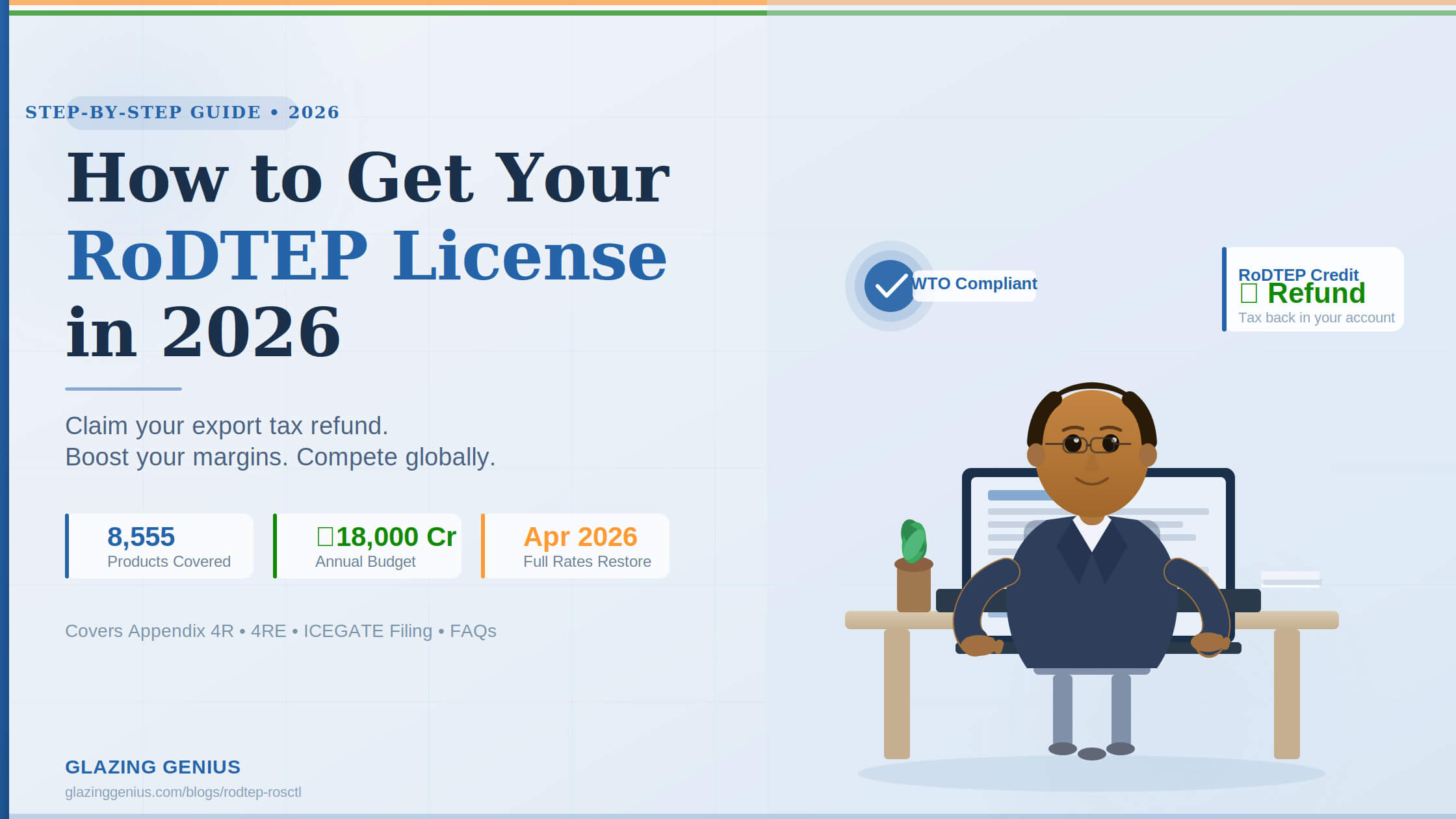

Understanding the RoDTEP Scheme
The RoDTEP Scheme, or Remission of Duties and Taxes on Exported Products, is an initiative by the Government of India to enhance export competitiveness.
The RoDTEP full form is Remission of Duties or Taxes on Export Product explains its core purpose—refunding unrefunded taxes and duties that affect export pricing. Thegovt notifies RoDTEP rates guidelines periodically to ensure transparency and fairness for exporters. This RoDTEP Scheme for exporters helps reimburse hidden costs like fuel tax, electricity duty, and local levies. Under theRoDTEP Scheme India, benefits are credited digitally to exporters’ accounts via the ICEGATE portal, ensuring quick access and accuracy. By defining RoDTEP meaning clearly and implementing standardized RoDTEP rates, the government ensures Indian goods remain competitive globally, boosting exports and supporting economic growth here in it.
Introduction to the RoDTEP Scheme
- RoDTEP: It stands for — Remission of Duties and Taxes on Exported Products.The RoDTEP Scheme refunds hidden export taxes, enhancing India’s trade competitiveness and supporting exporters through transparent, digital tax remission benefits.
- Objective: The key objective of the RoDTEP Scheme is to refund embedded taxes and levies to exporters, making Indian goods globally competitive. It ensures tax neutrality, promotes cost-efficient exports, and supports sustainable growth in India’s international trade.
Why was the RoDTEP Scheme Introduced?
RoDTEP was introduced for covering these basic points which gave new direction and also inrtoduced new category in it as-
- Mention the replacement of MEIS (Merchandise Exports from India Scheme).
- Highlight compliance with WTO guidelines.
- State how it helps make Indian goods more competitive globally.
Replacement of MEIS (Merchandise Exports from India Scheme):
The RoDTEP Scheme was launched as a replacement for the MEIS Scheme, which was phased out due to non-compliance with global trade norms. RoDTEP introduces a more transparent and WTO-compliant structure to support exporters by refunding embedded taxes effectively.
Compliance with WTO Guidelines:
The RoDTEP Scheme aligns with WTO regulations by ensuring that export incentives are not considered prohibited subsidies. It provides tax-neutral benefits to exporters while maintaining India’s commitment to fair international trade practices and sustainable export promotion.
Enhancing Global Competitiveness:
By refunding hidden taxes and levies, the RoDTEP Scheme reduces export costs and boosts profit margins. This helps make Indian goods more competitive globally, encouraging exporters to expand into new markets and strengthen India’s trade position worldwide.
Key Features of the RoDTEP Scheme
The RoDTEP Scheme offers exporters tax refunds on hidden levies and duties not covered under other schemes. It provides digital rebate credits transferable through an electronic system, ensuring transparency and ease of use. The scheme covers all sectors, including small exporters, promoting competitiveness, compliance with WTO norms, and simplifying export incentive distribution across India.
Difference between the MEIS and RoDTEP
| Basis of Difference | MEIS (Merchandise Exports from India Scheme) | RoDTEP (Remission of Duties and Taxes on Exported Products) |
| Objective | To incentivize exports by offering rewards based on the export value. | To refund embedded taxes and duties not refunded under any other scheme. |
| WTO Compliance | Not compliant with WTO subsidy guidelines. | Fully compliant with WTO trade rules and international standards. |
| Nature of Benefit | Provided duty credit scrips as export incentives. | Provides digital rebate of taxes and levies through e-credit ledger. |
| Coverage | Limited to selected sectors and tariff lines. | Covers all export sectors, including MSMEs and labor-intensive industries. |
| Mode of Transfer | Paper-based scrips were issued. | Entirely electronic and automated via the Customs system. |
| Focus Area | Reward-based export incentive scheme. | Refund-based scheme ensuring cost competitiveness of exports. |
| Replacement | Discontinued due to WTO objections. | Introduced as a WTO-compliant replacement of MEIS in January 2021. |
Benefits of the RoDTEP Scheme for Exporters
The RoDTEP Scheme offers multiple benefits to Indian exporters, making it a crucial reform in the country’s trade policy. Firstly, it reduces the cost burden for exporters by reimbursing embedded taxes and levies that were previously non-recoverable, helping businesses improve profitability.
Secondly, it enhances the global competitiveness of Indian goods by lowering production and export costs, allowing exporters to offer more competitive prices in international markets. Lastly, it promotes export diversification and economic growth by supporting various sectors, including MSMEs, and encouraging new players to participate in global trade. Overall, the scheme strengthens India’s export ecosystem, improves trade balance, and contributes to sustainable economic development by aligning with global trade norms and ensuring fair compensation to exporters.
How to claim RoDTEP Benefits
- Ensure eligibility
Export must be of goods manufactured in India and filed under an EDI/ICEGATE shipping bill. Your IEC and GST details should be valid.
- Declare RoDTEP in the Shipping Bill
While filing the shipping bill on ICEGATE, select/declare that you are claiming RoDTEP for the relevant items (use the prescribed statement code/statement table . Without this declaration the claim cannot be admitted.
- File Export General Manifest (EGM)
After shipment, the carrier files the EGM. Customs processes the declared shipping bills once EGM is recorded. Claims are examined during customs processing.
- Customs processing & scroll creation
Customs validates the shipping bills and generates a scroll (collection of processed shipping bills) showing admissible RoDTEP amounts. That scroll appears in your ICEGATE e-Scrip / RoDTEP ledger.
- Create / access your e-Scrip (RoDTEP) ledger on ICEGATE
If not already done, register for and open an e-scrip / RoDTEP ledger in ICEGATE (Financial Services → eScrip). The scrolls / credit entries will be visible here.
- Generate e-scrips (if applicable)
From the ledger, use the Scrip Generation function to create unique RoDTEP e-scrip(s) tagged to your IEC. Each scrip will have a number and value.
- Utilize or transfer RoDTEP credits
You can use RoDTEP e-scrips to pay Basic Customs Duty on imports (apply in Bill of Entry), or transfer/sell the scrip to another IEC holder through ICEGATE (transfer requires OTP/approval flows).
- Maintain records & file Annual Return (if required)
Keep copies of shipping bills, scrolled amounts and scrips. If your annual RoDTEP claims for an IEC exceed ₹1 crore, you must file the Annual RoDTEP Return (ARR) on DGFT portal by March 31 following the FY.
- Watch rate notifications & exclusions
Check DGFT/Customs notifications for updated RoDTEP rates and any sectoral exclusions before claiming. Rates are notified in Appendix/updates on DGFT.
10. Seek help if claim is not credited
If credits don’t appear, contact your Customs house/ICEGATE helpdesk and refer to DGFT/ICEGATE advisories; maintain shipping bill/EGM proof for audit.
Conclusion:
The RoDTEP Scheme plays a crucial role in strengthening India’s export ecosystem by ensuring that exporters receive refunds for previously unrefunded taxes and levies. By replacing the MEIS and aligning with WTO-compliant guidelines, RoDTEP enhances transparency and fairness in trade incentives. This initiative not only reduces the cost burden on exporters but also improves the global competitiveness of Indian goods. Through its structured digital implementation, the scheme promotes sustainable export growth, contributing significantly to India’s economic development and international trade expansion.
FAQ:
1. What is the RoDTEP Scheme?
The RoDTEP (Remission of Duties and Taxes on Exported Products) Scheme refunds hidden taxes and duties paid by exporters to make Indian products more competitive globally.
2. Why was the RoDTEP Scheme introduced?
It was introduced to replace the MEIS (Merchandise Exports from India Scheme) and ensure India’s export incentives comply with WTO trade rules.
3. Who is eligible to claim benefits under RoDTEP?
All exporters of goods from India, including manufacturer exporters and merchant exporters, are eligible to claim RoDTEP benefits, subject to government notifications.
4. How are RoDTEP benefits provided to exporters?
Benefits are provided in the form of transferable electronic scrips (e-scrips), which can be used to pay basic customs duty.
5. How can exporters apply for RoDTEP benefits?
Exporters can claim RoDTEP benefits while filing their shipping bills on the ICEGATE portal, ensuring they select the RoDTEP option during export documentation.
6. How are RoDTEP rates determined?
The government notifies RoDTEP rates based on sector-specific taxes and duties embedded in production and export processes.
7. What types of taxes and duties are refunded under RoDTEP?
The scheme refunds unrebated taxes like electricity duty, mandi tax, fuel tax, and embedded levies not covered under GST or other refund mechanisms.
8. Is RoDTEP applicable for service exports?
No, currently the RoDTEP Scheme applies only to goods exports, not to services or deemed exports.
9. What is the validity of RoDTEP e-scrips?
RoDTEP e-scrips are valid for one year from the date of issue and can be transferred or sold through the ICEGATE portal.
10. How does RoDTEP help Indian exporters?
RoDTEP reduces hidden export costs, enhances price competitiveness, promotes export diversification, and strengthens India’s position in global trade markets.
Related Posts:
DGFT IEC Registration: Step-by-Step Guide for New Exporters
RoDTEP Scheme Explained: Understand How to Claim Your Refund in 2026