

How to Register a Company in India
If you’re planning to register a company in India, it is essential to complete the legal formalities to operate legally. Business registration ensures compliance with regulations, provides legal protection, and builds credibility, creating a strong foundation for growth and smooth business operations.
Read our complete blog for clear guidance and a smooth, hassle-free business registration process.
Key Insights
- Business registration ensures legal recognition, compliance, and credibility.
- Required documents include PAN, Aadhaar, photographs, address proof, MOA, AOA, and directors’ declarations.
- Proper registration lays a strong foundation for smooth operations and long-term success.
Why Business Registration is Important
Registering a business is essential for legal recognition, compliance with government regulations, and establishing a credible presence in the market. It protects personal assets through limited liability, enables access to tax benefits, government schemes, and funding opportunities, and provides a structured foundation for growth, risk management, and long-term business sustainability.
Documents Required for Business Registration
Entrepreneurs and Startup Company in the process of beginning a company registration are interested in knowing about the list of documents required for the process. Here this blog, we provide details and descriptions of the documents required for company registration.
The following documents are mandatory for Indian Nationals for incorporation of company in India:
PAN Card: PAN Card copy of the proposed Directors of the Company will be required for Company Registration. PAN or Permanent Account Number is a unique identification number issued by the Department of Income Tax in India. It is mandatory for Directors who are Indian Nationals to submit PAN during the incorporation process.
Address Proof: In addition to the PAN Card copy, the proposed Director must submit an address proof. The address proof submitted must have the name of the Director as mentioned in the PAN Card and the most current address of the Director. Further, the document must also not be older than 2 months. The following documents are acceptable address proof for Indian Nationals.
Passport
Election Card or Voter Identity Card
Ration Card
Driving License
Electricity Bill
Telephone Bill
Aadhaar Card
Residential Proof: In addition to the address proof, a residential proof must be submitted during the incorporation of the Company to validate the current address of the Director. As applicable for address proof, the residential proof must also contain the name of the Director as mentioned in the PAN Card and must not be older than two months. The following documents are acceptable residential proof:
Bank Statement
Electricity Bill
Telephone Bill
Mobile Bill
Types of Business Entity
Below are the key types of business entity in India and their features to help you choose the right one for your venture.
1. Sole Proprietorship
Owned and managed by one individual. Simple to set up but involves unlimited personal liability. Best suited for independent entrepreneurs and small businesses.
2. Partnership
Owned and managed by two or more individuals who share profits, losses, and operational responsibilities. Personal liability applies. Suitable for small firms pooling skills and resources.
3. One Person Company (OPC)
Offers single ownership with limited liability, protecting personal assets while enhancing credibility.
4. Limited Liability Partnership (LLP)
Combines partnership flexibility with limited liability protection. Favored by professionals and small service firms.
5. Private Limited Company
Separate legal entity with limited liability. Ideal for startups and growth-oriented businesses, allowing easier access to capital.
6. Public Limited Company
Suitable for medium to large businesses seeking to raise funds from the public, with limited liability for shareholders.
Steps to Register a Business in India
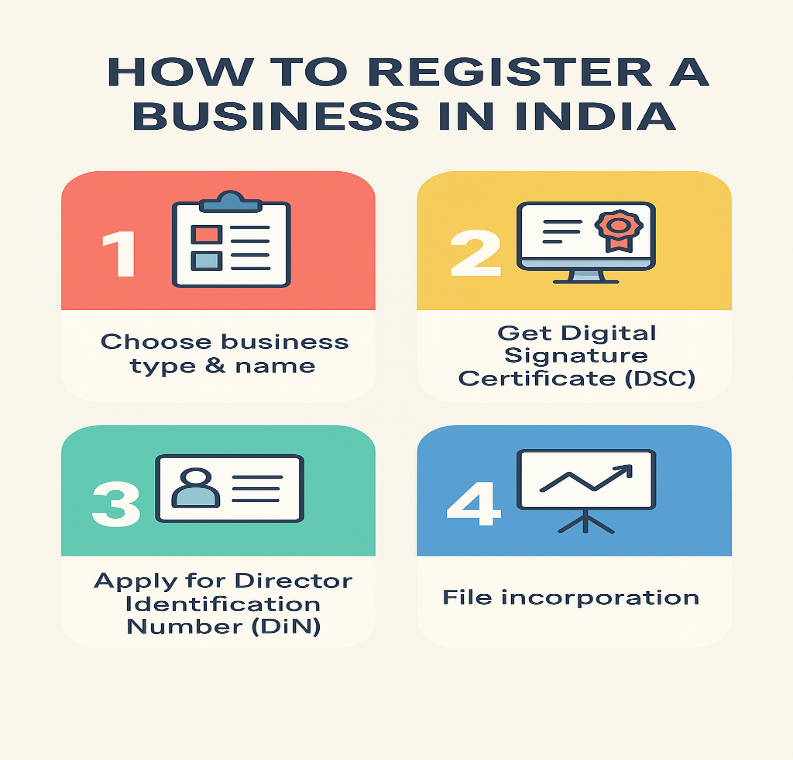
Step 1: Choose Business Type and Name
The first step is to decide the type of business structure you want to register — such as a Private Limited Company, Limited Liability Partnership (LLP), One Person Company (OPC), or Sole Proprietorship. Each structure has different compliance and tax requirements. After selecting the structure, choose a unique business name that is not already registered or trademarked. The name should reflect your brand identity and meet the naming guidelines set by the Ministry of Corporate Affairs (MCA).
Step 2: Get Digital Signature Certificate (DSC)
Since business registration in India is now fully online, every director or partner must obtain a Digital Signature Certificate (DSC). This digital key is used to sign documents electronically on the MCA portal. Class 3 DSC is mandatory for filing incorporation forms and ensures authenticity and security of all documents submitted online.
Step 3: Apply for Director Identification Number (DIN)
Every person who wishes to become a director in a company must have a Director Identification Number (DIN). It is a unique identification number issued by the MCA. DIN can be obtained while filing the SPICe+ (Simplified Proforma for Incorporating Company Electronically Plus) form. This step ensures that each director’s details are properly verified and recorded.
Step 4: File Incorporation
Once you have your DSC and DIN, you can proceed to file the SPICe+ form on the MCA portal. This form includes all required details like company name, address, directors’ information, and share capital. After verification, the Registrar of Companies (ROC) issues a Certificate of Incorporation with your company’s PAN and TAN. This officially establishes your business as a legal entity in India here in it.
Post-Registration Requirements for Business Entities
1. Open a Business Bank Account
It is mandatory to separate personal and business finances and to handle company transactions.
2. Apply for Udyam (MSME) Registration
Optional but beneficial for micro, small, and medium enterprises to access government benefits, schemes, and subsidies.
3. Obtain Additional Licenses
Depending on the nature of your business, licenses such as Import Export Code (IEC), Shop & Establishment License, FSSAI, GST, or other sector-specific approvals may be required.
4. Maintain Statutory Registers and Compliance Filings
Companies must maintain statutory records (Register of directors, Shareholding) and file annual returns, financial statements, and other compliance documents with the MCA.
Conclusion:
Registering a business in India is essential for legal recognition, compliance, and building credibility. By selecting the right business structure, completing all required registrations, and fulfilling post-registration formalities, entrepreneurs can establish a strong foundation for growth and long-term success. Careful planning ensures a smooth, efficient, and hassle-free business setup process here in it.
FAQs:
1. What is business registration?
Business registration is the legal process of establishing a company in India, providing a legal identity, compliance, and credibility.
2. Why is business registration important?
It ensures legal recognition, protects personal assets, enables access to tax benefits, government schemes, and supports business growth.
3. What are the types of business entities in India?
Common types include Sole Proprietorship, Partnership, OPC, LLP, Private Limited, and Public Limited Company, each with different liability and compliance structures.
4. What is a Digital Signature Certificate (DSC)?
A DSC is an electronic signature required to securely submit online registration documents to the MCA.
5. What is a Director Identification Number (DIN)?
A DIN is a unique identifier issued by the MCA for all directors to ensure legal recognition and accountability.
6. What documents are needed for registration?
Documents include PAN, Aadhaar, photographs, address proof, registered office proof, MOA, AOA, and directors’ declarations.
7. What are post-registration requirements?
Businesses must open a bank account, apply for Udyam registration if eligible, obtain necessary licenses, and maintain statutory records and compliance filings.
Related Posts:
DGFT IEC Registration: Step-by-Step Guide for New Exporters
RoDTEP Scheme Explained: Understand How to Claim Your Refund in 2026