RoDTEP Scheme Explained: Understand How to Claim Your Refund in 2026
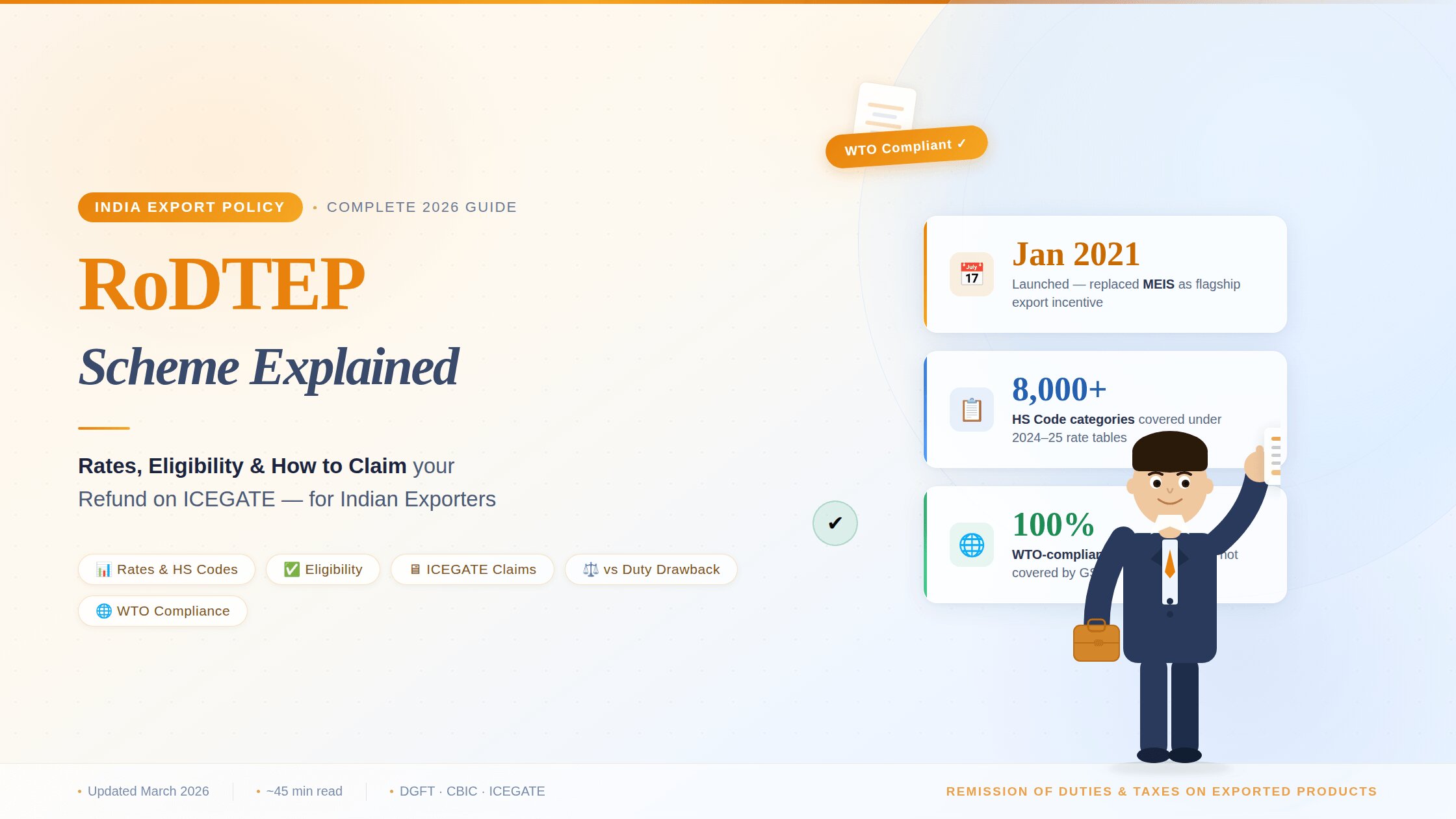
To claim your RoDTEP refund, you must declare your intent in the Shipping Bill at the time of export. Once your goods are exported and the shipping line files the Export General Manifest (EGM), ICEGATE automatically transfers the credits to your account as transferable scrips. RoDTEP (Remission of Duties and Taxes on Exported Products) is India’s flagship export incentive scheme that refunds embedded taxes and duties not covered by GST, helping Indian exporters compete globally on a level playing field.
What Is the RoDTEP Scheme?
Think of RoDTEP as a tax refund for the invisible taxes baked into your export products. When you manufacture goods for export in India, you pay dozens of state and central levies that you cannot reclaim under GST. Fuel taxes on transport trucks, mandi fees on agricultural inputs, electricity duties on your factory, stamp duties on trade documents — all of these silently raise your product cost and erode your competitiveness.
RoDTEP (Remission of Duties and Taxes on Exported Products) is a Government of India scheme, notified under the Foreign Trade Policy (FTP), that refunds these embedded duties and taxes as a percentage of your Free On Board (FOB) export value. It replaced the older MEIS (Merchandise Exports from India Scheme) on January 1, 2021, and the government later extended and expanded it through 2025 under the Foreign Trade Policy 2023.
DGFT (Directorate General of Foreign Trade) and CBIC (Central Board of Indirect Taxes and Customs) jointly administer the scheme, and exporters process all claims through the ICEGATE (Indian Customs Electronic Gateway) portal.
Key terms you need to know:
- DGFT: Directorate General of Foreign Trade — the nodal agency under the Ministry of Commerce that governs India’s export-import policies.
- IEC: Importer Exporter Code — a mandatory 10-digit identifier you must have to export from India.
- BCD: Basic Customs Duty — the primary duty levied on imports, which is separate from GST.
- SION: Standard Input Output Norms — pre-defined input-output ratios for specific export products used in duty drawback and advance authorization calculations.
- FOB Value: Free On Board value — the price of your goods at the port of export, excluding freight and insurance.
- EGM: Export General Manifest — the document a shipping line files with customs after a vessel departs, confirming the goods have left India.
- LEO: Let Export Order — the customs officer’s authorization confirming your goods are cleared for export.
- DTA: Domestic Tariff Area — the standard manufacturing and trading zone in India, as distinct from SEZ or EOU zones.
- EOU: Export Oriented Unit — a manufacturing unit approved for duty-free import of inputs against an obligation to export its production.
- AA: Advance Authorization — a duty exemption scheme for import of inputs used in export production.
What Did RoDTEP Replace (MEIS), and Why?
The MEIS (Merchandise Exports from India Scheme) served as India’s primary export incentive from 2015 to 2020. It offered duty credit scrips worth 2% to 5% of FOB value across a wide range of products — and exporters widely praised it as popular, simple, and generous.
However, a serious problem emerged. In 2019, the World Trade Organization (WTO) ruled that MEIS violated its subsidy norms under the Agreement on Subsidies and Countervailing Measures (ASCM). Several countries, led by the United States, challenged MEIS as an illegal export subsidy at the WTO Dispute Settlement Body. India lost the case, and the government had to act fast.In response, the government designed RoDTEP from scratch to be WTO-compliant. Here is how it differs from MEIS:
| Feature | MEIS (Old Scheme) | RoDTEP (Current Scheme) |
|---|---|---|
| Nature of benefit | Incentive / subsidy | Remission of actual taxes paid |
| WTO compliance | Non-compliant (ruled illegal) | Fully WTO-compliant |
| Basis of calculation | % of FOB value (fixed rate) | Scientifically determined based on actual tax burden |
| Coverage | Broad, including incentives | Only taxes/duties not refunded elsewhere |
| Benefit form | Duty credit scrips | Duty credit scrips (transferable) |
| Applicable from | April 2015 | January 1, 2021 |
| Rate revision | Infrequent | Periodic, based on cost studies |
The RoDTEP Committee, chaired by Dr. G.K. Pillai (former Commerce Secretary), conducted an extensive study across industries to determine the embedded tax burden on each product category. This scientific approach is what makes RoDTEP defensible at the WTO.
How Does RoDTEP Scrip Work?
The RoDTEP benefit does not come to you as cash. It comes as an electronic duty credit called a RoDTEP scrip. Here is exactly how the pipeline works from export to credit.
Step 1: Declaration at Shipping Bill stage
You declare your intent to claim RoDTEP benefits by selecting “Y” (Yes) in the RoDTEP claim field when filing your Shipping Bill on ICEGATE. This is the most critical step. If you miss it, you cannot claim retrospectively for that shipment.
Step 2: Customs officer grants LEO
After examination, the customs officer issues the Let Export Order (LEO), permitting your goods to physically leave India.
Step 3: EGM filing by shipping line
Once the vessel departs, the shipping line files the Export General Manifest (EGM) with customs. This confirms the goods have left Indian shores.
Step 4: Automated credit calculation
The ICEGATE system automatically calculates your RoDTEP credit based on the HS code of your product and its FOB value. The rate comes from the official RoDTEP Rate Schedule notified by the Ministry of Commerce.
Step 5: Credit transferred to your ICEGATE ledger
The credit appears in your Electronic Credit Ledger on ICEGATE as a transferable scrip with a unique scrip number.
Step 6: Utilisation or transfer
You can use these scrips to pay Basic Customs Duty (BCD) on your own imports. Alternatively, you can transfer (sell) them to another importer through ICEGATE. Scrips are freely tradeable, which means even if you do not import goods yourself, you can monetize the benefit in the market.Scrip trading in practice: The secondary market for RoDTEP scrips is active and liquid. Scrips typically trade at 95% to 99% of face value. Buyers are importers who pay BCD and want to offset that duty cost at a slight discount versus paying cash. You can transfer scrips directly through the ICEGATE Duty Credit Scrip module by entering the buyer’s IEC and the transfer amount. No separate broker or exchange is required — the transfer is entirely government-portal-based.
Am I Eligible for RoDTEP? (Eligibility Criteria)
Not every export qualifies for RoDTEP. Do check all of the following boxes before filing a claim.
You are eligible if:
- You hold a valid IEC (Importer Exporter Code) issued by DGFT.
- Your product’s HS code appears in the RoDTEP Rate Schedule with a non-zero rate.
- Your goods were physically exported from India (not deemed exports).
- You declared your intent to claim RoDTEP on the Shipping Bill at the time of export.
- Your export is not under an Advance Authorization or Export Promotion Capital Goods (EPCG) scheme for the same inputs (to avoid double benefit).
- The export destination is not specifically excluded.
You are NOT eligible if:
- The RoDTEP schedule specifically excludes your product (many pharma, chemical, and steel products carry zero rates).
- You exported under Special Economic Zones (SEZ), where duty-free inputs are already available.
- Your shipment is a Special Valuation Branch (SVB) shipment with a pending transaction value dispute.
- You are claiming Duty Drawback on the same taxes for the same product.
Note: RoDTEP and Duty Drawback can coexist for the same shipment, but they cannot refund the same tax twice. CBIC has notified specific excluded categories in its rate schedules.
Merchant Exporters vs. Manufacturer Exporters
The distinction between a merchant exporter and a manufacturer exporter is one of the most practically important — and most commonly misunderstood — aspects of RoDTEP eligibility. Both are eligible, but the way the benefit flows and the scrutiny each faces are significantly different.
Who Is Who?
| Category | Definition | Common Examples |
|---|---|---|
| Manufacturer Exporter | Manufactures the exported goods itself and exports directly in its own name | Garment factory, pharma company, engineering goods manufacturer |
| Merchant Exporter | Purchases goods from a manufacturer and exports them in its own name without manufacturing | Export trading house, commodity trader, sourcing company |
| Manufacturer-cum-Merchant | Both manufactures some goods and sources others for export | Large conglomerate with own production and sourcing arm |
| Status Holder Exporter | Exporter with elevated export performance — Star Export House, Trading House, etc. | Companies with DGFT Status Holder certificate |
Key Differences in Practice
| Parameter | Manufacturer Exporter | Merchant Exporter |
|---|---|---|
| Who files the Shipping Bill? | The manufacturer, in its own name | The merchant/trader, in its own name |
| Who gets the RoDTEP credit? | The manufacturer (Shipping Bill filer) | The merchant (Shipping Bill filer) |
| Does the manufacturer also get credit? | Yes — they filed the SB | No — manufacturer cannot claim on goods the merchant exported |
| Rate applied | Standard Appendix 4RE rate for HS code | Same rate — no separate lower rate for merchants |
| Scrutiny level | Lower (direct nexus between taxes and export) | Higher (CBIC may query whether embedded taxes were actually borne) |
| GST refund interaction | Refunds ITC on own manufacturing inputs | Must have GST invoice from manufacturer to claim ITC; exports under LUT |
| IEC requirement | Own IEC | Own IEC, separate from manufacturer’s IEC |
| Annual Return | File own return | File own return for all SBs under their IEC |
The Core Issue: Who Really Bore the Embedded Tax?
RoDTEP remits embedded taxes paid during manufacturing. A merchant exporter did not manufacture the goods — so what taxes are being remitted on their behalf? The answer: the taxes embedded in the price they paid to the manufacturer, which the manufacturer could not separately recover because the merchant is the exporter of record. The merchant effectively absorbs the embedded tax cost through the purchase price and recovers it via RoDTEP.
This creates a commercial negotiation dynamic: manufacturers sometimes factor the potential RoDTEP credit into their pricing. Whether the merchant passes back any portion of the scrip to the manufacturer is entirely a private commercial arrangement. There is no legal mechanism requiring a merchant to share scrips with the manufacturer — once the scrip is in the merchant’s ICEGATE ledger, it belongs to the merchant.
Common Pitfalls for Merchant Exporters
- Claiming on goods not genuinely procured: Claiming RoDTEP on goods that you did not purchase from a domestic manufacturer constitutes fraud. CBIC’s Risk Management System and FEMA cross-checks flag fictitious export patterns.
- Aggregated exports: Many merchants consolidate goods from multiple manufacturers into a single shipment. The rate and credit apply to the total FOB value on that Shipping Bill. Ensure HS codes for all aggregated goods are correctly declared.
- Status Holder advantages: Merchant exporters with a DGFT Status Holder certificate get faster Shipping Bill clearance and reduced RMS scrutiny, but no additional RoDTEP rate benefit.
Status Holder Categories
| Category | Annual Export Threshold (FOB) | Relevant Benefits |
|---|---|---|
| One Star Export House | USD 3 million | Self-certification; faster clearance |
| Two Star Export House | USD 25 million | Green channel processing |
| Three Star Export House | USD 100 million | Priority processing; dedicated DGFT facilitation |
| Four Star Export House | USD 500 million | Direct DGFT HQ access |
| Five Star Export House | USD 2 billion | Policy-level access; represented in CCEA rate revision discussions |
Export Oriented Units (EOUs) — Full Eligibility & Process
EOUs are a distinct category of exporter operating under a special government-approved regime. Their interaction with RoDTEP is significantly different from a standard DTA exporter, and confusion here is very common.
What Is an EOU?
An Export Oriented Unit (EOU) is a manufacturing unit granted special status under the EOU Scheme (Chapter 6, Foreign Trade Policy 2023) that allows it to import inputs — raw materials, capital goods, consumables — duty-free, with the obligation to export its entire production. EOUs are approved by the Development Commissioner (DC) of the relevant authority.
Critical distinction: EOUs are NOT the same as SEZ units. SEZ units are NOT eligible for RoDTEP. EOUs in certain categories ARE eligible for RoDTEP, but with restrictions.
EOU Eligibility Matrix
| EOU Category | RoDTEP Eligible? | Reason / Condition |
|---|---|---|
| EOU exporting directly to overseas markets | Yes — partially | Eligible only for taxes on domestically sourced inputs not covered by duty exemption |
| EOU supplying to DTA (deemed export) | No | Deemed exports are explicitly excluded from RoDTEP |
| EOU using 100% duty-free imported inputs | No / Reduced rate | No embedded domestic taxes to remit; CBIC reduces rate accordingly |
| EOU with domestic procurement (electricity, local services) | Yes — for domestic input taxes only | State electricity duties, mandi fees on domestic agri inputs are eligible |
| EOU located in SEZ | No | SEZ regime is fully duty-free; no embedded domestic taxes |
What Taxes Can EOUs Claim?
Since EOUs import most inputs duty-free, their claimable embedded taxes are more limited than DTA exporters. Eligible taxes for EOUs include:
- State electricity duties on power consumed in manufacturing
- Mandi fees / market cess on domestically procured agricultural inputs
- Stamp duties on domestic trade documents
- Fuel levies on domestically purchased transport and logistics
- Local body taxes on domestic services
EOUs cannot claim remission on taxes that were never paid — i.e., on duty-free imported inputs.
EOU-Specific RoDTEP Process: How It Differs from DTA
| Process Step | DTA Exporter | EOU Exporter |
|---|---|---|
| IEC requirement | Standard IEC from DGFT | Same IEC, plus EOU registration number from Development Commissioner |
| Shipping Bill declaration | Select ‘Y’ for RoDTEP claim | Select ‘Y’ AND enter EOU registration details in the designated field |
| Rate applied | Standard Appendix 4RE rate for HS code | Reduced rate — CBIC applies a lower rate for EOUs to reflect duty-free inputs |
| ICEGATE verification | Standard customs verification | ICEGATE cross-checks EOU status with DC records before generating scroll |
| Annual Return | File on DGFT portal by Sept 30 | Same, but must also reconcile with EOU Annual Progress Report filed with DC |
EOU Compliance Hierarchy
Before claiming RoDTEP, an EOU must maintain compliance across three layers simultaneously. A lapse in any one layer can block credit generation:
- Development Commissioner (DC) compliance: Annual Performance Report (APR), Net Foreign Exchange (NFE) requirement compliance, and valid unit approval.
- Customs compliance (CBIC): Bond and LUT (Letter of Undertaking) filing, reconciliation of duty-free imports with exports, and no pending show-cause notices.
DGFT compliance: Active IEC, no debarment orders, Annual Return filed on time.
HS Code-Wise RoDTEP Rate Table
The RoDTEP rate schedule runs into thousands of HS code entries. Below is a representative table of key sectors and their rates as notified. Always verify the current rate against the official DGFT / CBIC notification before filing, as rates are subject to periodic revision.
Important: Rates are expressed as a percentage of FOB value. All rates below are indicative of the 2023-25 schedule. Always cross-check with the latest DGFT Appendix 4RE for current rates.
| HS Code Range | Product Category | RoDTEP Rate (% of FOB) | Cap (₹ per unit) |
|---|---|---|---|
| 5208 | Cotton woven fabrics (plain weave) | 1.4% | ₹17/kg |
| 5209 | Cotton fabrics, >= 200 g/m2 | 1.3% | ₹15/kg |
| 6109 | T-shirts, cotton knitted | 1.7% | ₹22/piece |
| 6203 | Men’s suits, ensembles | 1.6% | ₹90/piece |
| 6302 | Bed linen, cotton | 1.5% | ₹18/kg |
| 0306 | Crustaceans (shrimp, prawn) | 2.0% | ₹50/kg |
| 0302 | Fresh/chilled fish | 1.8% | ₹30/kg |
| 7214 | Bars/rods, iron or non-alloy steel | 0.5% | ₹3/kg |
| 8708 | Parts and accessories, motor vehicles | 1.1% | ₹80/piece |
| 8544 | Insulated wire and cable | 1.2% | ₹45/kg |
| 2309 | Preparations for animal feeding | 1.0% | ₹25/kg |
| 0901 | Coffee, not roasted | 1.7% | ₹40/kg |
| 4107 | Leather, bovine/equine | 1.3% | ₹35/sq.m |
| 6403 | Footwear with leather outer sole | 1.4% | ₹30/pair |
| 3004 | Medicaments (packaged) | 1.0%* | Varies |
| 2701 | Coal (specific grades) | 0.0% | Not applicable |
| 7207 | Semi-finished products of iron | 0.5% | ₹4/kg |
| 8471 | Automatic data-processing machines | 0.0% | Not applicable |
*Pharma rates vary widely by product. Many active pharmaceutical ingredient (API) categories carry zero rates.
How to find your exact rate:
- Identify your product’s 8-digit HS code from the Indian Customs Tariff.
- Visit DGFT’s Appendix 4RE or the CBIC notification on RoDTEP rates.
- Search your HS code in the notification table.
- Note the rate (%) and the per-unit cap (whichever gives a lower benefit applies).
Rate Revision Process — How and When Rates Change
The government does not permanently fix RoDTEP rates. It reviews them periodically based on cost studies, industry representations, and WTO compliance requirements. Understanding how revisions happen — and how to track them — is essential for accurate financial planning.
Who Decides the Rates?
RoDTEP rates are determined through a multi-body process:
- RoDTEP Committee: A government-appointed high-powered committee (originally chaired by Dr. G.K. Pillai) that conducts scientific cost studies across product categories to compute the actual embedded tax burden and recommends rates to the Ministry.
- Ministry of Commerce & Industry: The nodal authority that approves and notifies revised rates through DGFT.
- Cabinet Committee on Economic Affairs (CCEA): Approves major rate revisions before they are formally notified.
- CBIC: Publishes corresponding customs circulars to update ICEGATE’s automated rate calculation engine.
Historical Rate Revision Timeline
| Period | Type of Change | Key Development |
|---|---|---|
| January 2021 | Initial notification | RoDTEP launched; rates notified for approximately 8,555 tariff lines |
| August 2021 | First full rate notification | DGFT notified rates for all eligible product categories (Appendix 4RE) |
| December 2022 | Rate extension | Rates extended with minor adjustments for FY 2022-23 |
| March 2023 | FTP 2023 integration | Rates carried forward and reviewed under new Foreign Trade Policy 2023 |
| 2024-25 | Sector-specific revisions | Targeted revisions for textiles, marine, and select engineering goods |
Most sectors typically revise rates once every 12 to 18 months. Textiles and marine products tend to see more frequent attention due to active industry lobbying through their Export Promotion Councils.
The Rate Revision Process: Step by Step
- Industry representation: Export Promotion Councils (EPCs) and commodity boards submit data on actual tax burden to the RoDTEP Committee. Major councils include AEPC (Apparel), APEDA (Agri), MPEDA (Marine), and CHEMEXCIL (Chemicals).
- Cost study: The committee analyses embedded taxes — state levies, central levies, fuel surcharges, mandi fees — using actual data from representative exporters across the sector.
- Ministry approval: Committee recommendations go to the Ministry of Commerce, with major revisions requiring CCEA approval.
- DGFT notification: Revised rates are notified through a DGFT Public Notice amending Appendix 4RE of the Handbook of Procedures.
- CBIC circular: CBIC issues a corresponding customs circular to update ICEGATE’s rate calculation engine.
- Effective date: Revised rates apply prospectively from the notification date. The old rates govern shipments filed before the effective date — revisions do not apply retrospectively in either direction.
How to Track Rate Notifications
| Source | What to Track | How to Access |
|---|---|---|
| DGFT Website | Appendix 4RE updates, Public Notices on RoDTEP | dgft.gov.in → Policies → Foreign Trade Policy → Appendix 4RE |
| CBIC Website | Customs circulars on RoDTEP rate implementation | cbic.gov.in → Circulars → Customs Circulars |
| ICEGATE Portal | Rate changes reflected in Shipping Bill calculation | icegate.gov.in → Services → RoDTEP |
| Export Promotion Councils | Sector-specific alerts on rate changes | Your relevant EPC’s member portal or email alerts |
| Ministry of Commerce | Press releases and CCEA approvals | commerce.gov.in → Press Releases |
Pro tip: Subscribe to DGFT’s mailing list at dgft.gov.in for automatic email alerts on Public Notices. Your Export Promotion Council typically circulates rate change notices to members within 24 hours of DGFT notification.
Sector-Specific Deep Dives: Pharma, Textiles & Agriculture
RoDTEP rates and procedures are far from uniform across sectors. Each major export sector has its own rate structure, HS code complexities, and operational nuances. This section covers the three most important sectors in depth.
Pharmaceutical Sector
India is the world’s third-largest pharma producer by volume and a major exporter. The RoDTEP treatment of pharma is complex because the sector is politically sensitive at the WTO level and many products carry zero rates.
Rate Structure in Pharma
| Category | Typical HS Range | RoDTEP Rate | Notes |
|---|---|---|---|
| Formulations (finished drugs, packaged) | HS 3004 | 0.5% – 1.5% | Rates vary by dosage form; injectables often at higher end |
| APIs (Active Pharmaceutical Ingredients) | HS 2941, 2933, 2934 | 0% – 0.5% | Many bulk API categories carry zero rate — verify each HS code |
| Intermediates | HS 2914, 2915, 2918 | 0% – 0.7% | Rate depends on complexity; often excluded or zero |
| Vaccines and biologics | HS 3002 | 0% | Explicitly excluded — zero rate |
| Medical devices | HS 9018–9022 | 0.5% – 1.2% | Devices have a separate schedule from drugs |
| Diagnostic kits | HS 3822 | 0.5% – 1.0% | Verify at 8-digit level; rates vary significantly |
Why Are Many Pharma Rates Zero?
The RoDTEP Committee determined that many pharma categories — especially APIs and biologics — already receive significant duty exemptions on inputs through Advance Authorization or EPCG, making the net embedded domestic tax burden low or zero. Additionally, the government has been cautious about pharma incentives that could face WTO challenge.
Critical check for pharma exporters: Do not rely on a 4-digit or 6-digit HS code lookup. Two products sharing the same 6-digit code can have very different RoDTEP rates at the 8-digit level. Always verify your exact 8-digit code in DGFT Appendix 4RE.
Pharma-Specific Complexities
- Advance Authorization conflict: Pharma companies frequently use AA for duty-free import of APIs. If you are under AA for a specific product, you cannot claim RoDTEP for the same tax line on that product. Separate your AA and non-AA products carefully.
- DFIA interaction: Duty Free Import Authorisation-covered inputs create the same double-benefit conflict as AA. Track which inputs are DFIA-covered before calculating RoDTEP entitlement.
- Controlled substances: Narcotic and psychotropic exports require NDPS permits. RoDTEP claims on these are processed only after ICEGATE verifies valid permits.
- SION norms: Pharma SION norms are complex and must be current. Products without a SION may face scrutiny on input consumption ratios during audit.
Textile Sector
Textiles and garments are the most active users of RoDTEP, accounting for a significant share of total credit disbursed. AEPC and other councils most vocally represent the sector in rate revision discussions.
Rate Structure in Textiles
| Sub-Category | Typical HS Range | RoDTEP Rate | Typical Cap |
|---|---|---|---|
| Raw cotton (lint) | HS 5201 | 0.5% – 0.9% | ₹2–5/kg |
| Cotton yarn | HS 5205–5207 | 1.1% – 1.5% | ₹8–12/kg |
| Cotton woven fabrics | HS 5208–5212 | 1.2% – 1.6% | ₹12–20/kg |
| Cotton knitted garments (T-shirts, etc.) | HS 6109 | 1.5% – 1.9% | ₹18–28/piece |
| Woven garments (shirts, trousers) | HS 6201–6210 | 1.4% – 1.8% | ₹30–120/piece |
| Synthetic / man-made fibre fabrics | HS 5407–5516 | 0.8% – 1.3% | ₹10–18/kg |
| Home textiles (bed linen, towels) | HS 6301–6310 | 1.3% – 1.7% | ₹15–25/kg |
| Technical textiles | HS 5911 | 0.7% – 1.1% | ₹15–30/kg |
Textiles-Specific Nuances
- Per-unit cap is often the binding constraint: For lower-value textile products, the per-unit cap in ₹ per kg or per piece frequently limits the actual credit more than the percentage rate does. Always calculate both and apply whichever produces the lower benefit.
- Fibre mix classification: A fabric with 60% cotton and 40% polyester must be classified under the dominant fibre. Misclassification — such as filing under a cotton HS code when the product should be blended — causes wrong rate application and may trigger recovery notices.
- Job work complications: Many textile exporters outsource processing to job workers. RoDTEP accrues to the exporter of record (the Shipping Bill filer), not the job worker. Ensure contractual clarity on who files the Shipping Bill.
- TUFS interaction: Exporters who benefited from the Technology Upgradation Fund Scheme for machinery should ensure they do not overlap RoDTEP claims with capital goods-related taxes.
- State-wise variation in embedded taxes: Textile manufacturers in Gujarat, Tamil Nadu, Maharashtra, and Rajasthan face different state electricity duty rates and mandi fees. The national rate schedule already embeds these differences, but understanding the basis helps when you dispute a rate or make a rate revision representation through your EPC.
Agriculture & Marine Sector
Agricultural exports — including marine products — have some of the highest RoDTEP rates in the schedule, reflecting the heavy burden of state-level agricultural levies, particularly mandi fees. This sector also has the most active EPC engagement on rate revisions.
Rate Structure in Agriculture & Marine
| Sub-Category | HS Range | RoDTEP Rate | Notes |
|---|---|---|---|
| Basmati rice | HS 1006 | 0.5% – 1.2% | Rate sensitive to MSP levels and mandi fees |
| Non-basmati rice | HS 1006 | 0.3% – 0.8% | Often subject to export restrictions — verify policy before claiming |
| Fresh fruits (mangoes, grapes, etc.) | HS 0804–0810 | 1.5% – 2.5% | High rate reflects cold chain electricity and mandi fees |
| Vegetables | HS 0701–0714 | 1.0% – 2.0% | Varies by product; onions have separate treatment |
| Spices (cardamom, pepper, cumin) | HS 0904–0910 | 1.5% – 2.5% | Spice Board India is the relevant EPC |
| Shrimp and prawns | HS 0306 | 1.8% – 2.5% | Cap: ₹40–60/kg; MPEDA coordinates rate reviews |
| Fish (frozen) | HS 0303–0304 | 1.5% – 2.2% | Cold chain electricity duty is major embedded tax component |
| Processed food | HS 2101–2108 | 0.8% – 1.5% | Processed category carries a lower rate than fresh |
| Coffee | HS 0901 | 1.5% – 2.0% | Coffee Board India coordinates; cap applies |
| Tobacco products | HS 2401–2402 | 0% – 0.5% | WTO-sensitive; many excluded; verify at 8-digit level |
Agriculture-Specific Nuances
- Mandi fee is the biggest embedded tax: In agricultural commodities, the mandi fee (APMC fee, ranging from 0.5% to 2.5% depending on state and commodity) is the primary tax that RoDTEP remits. States like Uttar Pradesh, Maharashtra, and Punjab charge significantly higher mandi fees than Karnataka and Kerala.
- Export restrictions interact with RoDTEP: During periods when the government restricts or bans exports (onions, rice, wheat), RoDTEP claims on those products may be held or rejected. Always verify the current export policy under ITC-HS at DGFT before shipping restricted commodities.
- APEDA involvement: For processed food and certain fresh agri-products, APEDA registration is required. APEDA also runs its own support schemes — ensure no double-benefit overlap with RoDTEP.
- Phytosanitary certificates: For fresh produce, a Phytosanitary Certificate from NPPO (National Plant Protection Organization) is required alongside the Shipping Bill. Customs cross-checks this before granting LEO.
- Cold chain documentation: The electricity duty embedded in cold chain logistics is a significant component of the RoDTEP rate for marine products. Keep cold chain electricity bills if your claim is ever audited, as they substantiate the embedded tax claimed.
How Do I Claim RoDTEP Refund? (Step-by-Step Process on ICEGATE)
Here is the complete, numbered process to claim your RoDTEP refund from start to finish.
Phase 1: Pre-Export Preparation
Step 1: Verify your IEC is active on ICEGATE Log in to icegate.gov.in with your IEC credentials. Confirm your IEC is linked and active. If not, complete the IEC-ICEGATE linking process under “Register IEC.”
Step 2: Check your HS code and applicable RoDTEP rate Search your product’s HS code in the latest DGFT Appendix 4RE. Confirm the rate is non-zero. Note the per-unit cap if applicable.
Step 3: Ensure your Shipping Bill details are accurate Your FOB value, HS code, quantity, and unit of measurement on the Shipping Bill directly determine your credit amount. Errors here lead to incorrect credits or rejections.
Phase 2: At the Time of Export
Step 4: File the Shipping Bill on ICEGATE When filing your Shipping Bill (SB) on ICEGATE, navigate to the “Claim Details” section. In the RoDTEP claim field, select “Y” (Yes). This declaration is mandatory and cannot be added after the Shipping Bill is filed.
Step 5: Select the correct Shipping Bill type Use Shipping Bill type “S” (for RoDTEP claims) or the appropriate type per your export category. If you are also claiming Duty Drawback, select both claims in the respective fields.
Step 6: Submit and obtain the Shipping Bill number After filing, you receive a unique Shipping Bill number. Save this. You will need it for all future status checks.
Step 7: Clear customs and obtain LEO Present your goods at the customs examination area. After examination, the customs officer issues the Let Export Order (LEO). Your goods are now cleared for export.
Step 8: Ensure EGM is filed by the shipping line After your vessel departs, follow up with your freight forwarder to confirm the Export General Manifest (EGM) has been filed. Credits are not processed until EGM is filed. This typically happens within 2 to 5 working days of vessel departure.
Phase 3: Post-Export Credit Processing
Step 9: Check your RoDTEP scroll on ICEGATE Log in to ICEGATE. Go to “Services” > “RoDTEP” > “Scroll Status.” Enter your Shipping Bill number and date. You will see the status as “Pending,” “Scroll Generated,” or “Credit Issued.”
Step 10: View your Electronic Credit Ledger Once the scroll is generated, go to “Services” > “Duty Credit Scrips” > “View Ledger.” Your RoDTEP scrip will appear here with a unique scrip number, credit amount, and validity date.
Step 11: Utilize or transfer the scrip To use the scrip for paying BCD on your imports, select the scrip during your import Bill of Entry filing on ICEGATE and apply it against your duty liability. To transfer the scrip to another party, go to “Duty Credit Scrips” > “Transfer Scrip” and enter the transferee’s IEC and transfer amount.
Phase 4: Annual Return Filing
Step 12: File the RoDTEP Annual Return Exporters who claim RoDTEP must file an Annual Return on the DGFT portal by September 30 of the following financial year. Log in to dgft.gov.in. Go to “Services” > “RoDTEP Annual Return.” Declare all shipments, FOB values, and credits received during the financial year.
Air Cargo vs. Sea Cargo — Key Differences for RoDTEP
The RoDTEP scheme applies to both air and sea cargo exports. However, the process, timelines, and documentation differ significantly between the two modes. Understanding these differences prevents delays in credit processing.
Comparison at a Glance
| Parameter | Sea Cargo | Air Cargo |
|---|---|---|
| EGM equivalent | Export General Manifest (EGM) by shipping line | Air EGM filed by airline or Air Freight Station (AFS) |
| EGM filing timeline | 2–7 working days after vessel departure | Same day or next day after flight departure |
| LEO granting timeline | 0–2 days (same day possible for factory-stuffed containers) | Usually same day as Shipping Bill filing |
| RoDTEP scroll generation | 7–30 days after EGM | 5–15 days after Air EGM |
| Total credit timeline | 30–90 days from export date | 15–45 days from export date |
| Port codes used | Sea port codes (INMAA6 Chennai, INBOM4 Mumbai, etc.) | Airport codes (INMAA5 Chennai, INBOM7 Mumbai, etc.) |
| EGM filer | CHA (Customs House Agent) manages EGM | IATA-accredited Air Freight Station manages Air EGM |
| Risk of EGM delay | Moderate to high — shipping lines may batch-file | Low — airlines file promptly due to operational requirements |
| Typical goods | Bulk, heavy, or lower-value goods | Perishables, high-value, time-sensitive goods |
Air Cargo: Common Mistakes
- Wrong port code: Always use the airport customs code, not the IATA city code. Chennai airport customs code is INMAA5, not MAA. Use ICEGATE’s port code directory to verify.
- AFS vs. direct airline: If you ship through an Air Freight Station for consolidation, the AFS files the Air EGM, not the airline. Confirm EGM responsibility with your logistics partner before the shipment.
- Split shipments: Large air consignments are often split across multiple flights. Each AWB (Air Waybill) generates a separate Shipping Bill. Ensure every Shipping Bill has ‘Y’ declared for RoDTEP.
- Courier shipments: Small exports via courier (FedEx, DHL) file a consolidated Courier Shipping Bill. RoDTEP is available only for shipments above the de minimis threshold and when filed under the proper Shipping Bill type — not courier bills.
Sea Cargo: Specific Complexities
- Factory stuffing vs. port stuffing: If you stuff containers at your factory under Customs supervision, the LEO is granted at your premises. EGM is still filed at the port after vessel departure.
- Transhipment cargo: If your goods tranship through an intermediate port before the final destination, the EGM at the Indian port of loading triggers RoDTEP — not the port of final destination.
- LCL (Less than Container Load) shipments: LCL cargo moves through a Container Freight Station (CFS). The CFS consolidator handles EGM filing. Confirm this in your freight contract.
- Vessel departure delays: Port congestion can delay vessel departure by days or weeks. Your LEO remains valid; EGM is filed whenever the vessel actually departs.
Cash-flow tip: For perishable goods (marine, flowers, fruits) and high-value electronics, air cargo delivers RoDTEP credits 2–3 times faster than sea cargo. For bulk commodities, sea cargo is standard and the 60–90 day wait is industry norm.
What Is the Timeline from Shipment to Credit?
Many exporters are surprised that RoDTEP credits do not appear immediately. Here is a realistic timeline you can plan around.
| Stage | Sea Cargo Timeframe | Air Cargo Timeframe |
|---|---|---|
| Shipping Bill filing | Day 0 | Day 0 |
| LEO granted | Day 0 to Day 2 | Day 0 to Day 1 |
| Vessel / aircraft departure | Day 1 to Day 5 | Day 0 to Day 2 |
| EGM filed | Day 2 to Day 7 | Day 0 to Day 2 |
| RoDTEP scroll generation by ICEGATE | Day 7 to Day 30 | Day 5 to Day 15 |
| Credit visible in Electronic Ledger | Day 30 to Day 60 | Day 15 to Day 30 |
| Scrip available for use/transfer | Day 60 to Day 90 | Day 30 to Day 45 |
In practice, the ICEGATE system processes scrips in batches. High-volume periods (March, September) often see delays extending to 90 days from shipment date to credit availability.
What Is the Relationship Between RoDTEP and GST Refund?
This is one of the most common points of confusion for exporters. RoDTEP and GST refunds are two completely separate mechanisms.
GST refund on exports covers: – Input Tax Credit (ITC) accumulated on goods and services used in the production of exported goods. – GST paid under the Integrated Goods and Services Tax (IGST) route on export shipments.
You claim GST refunds through the GST portal (gst.gov.in) using Form GST RFD-01.
RoDTEP covers: – State-level taxes like mandi fees, toll taxes, and electricity duties. – Central taxes like fuel surcharges and stamp duties that are not recoverable under GST. – Any embedded tax that flows into your product cost but is not a GST input.
Think of them as two separate sieves catching different taxes. GST refunds catch the GST paid on inputs. RoDTEP catches everything else.Can you claim both? Yes. You can and should claim both GST refunds and RoDTEP benefits on the same shipment. They are not mutually exclusive. However, ensure you are not double-counting the same tax under both systems.
Common Mistakes That Delay RoDTEP Claims
Avoid these errors to keep your refunds on track.
Mistake 1: Not declaring “Y” at Shipping Bill stage This is the most fatal error. There is no retrospective amendment allowed. If you forget to declare RoDTEP intent at filing, that shipment’s credit is lost permanently.
Mistake 2: Using the wrong HS code Using a broad 6-digit HS code instead of the correct 8-digit code often results in a lower rate or a rejected scroll. Always use the full 8-digit HS code that matches your product exactly.
Mistake 3: FOB value mismatch If the FOB value on your invoice does not match the Shipping Bill, the customs system flags the discrepancy. Credits are put on hold until the mismatch is resolved through an amendment.
Mistake 4: EGM not filed or delayed Credits cannot be generated without EGM. If your freight forwarder delays EGM filing, your scroll generation is blocked. Follow up within 48 hours of vessel departure.
Mistake 5: Claiming RoDTEP on excluded categories Some exporters inadvertently claim RoDTEP on products that have zero rates or are explicitly excluded (such as certain pharma APIs and steel products). This triggers scrutiny and recovery notices.
Mistake 6: Not filing the Annual Return Failure to file the RoDTEP Annual Return by September 30 can lead to suspension of future claims and may invite scrutiny from DGFT.
Mistake 7: Attempting double benefits Claiming RoDTEP alongside Advance Authorization (AA) benefits for the same tax line on the same product is not allowed. CBIC’s reconciliation system flags this automatically.
Mistake 8: Wrong port code for air cargo Using the IATA city code instead of the correct ICEGATE airport customs code causes scroll generation failures for air cargo shipments. Always verify the port code in ICEGATE’s port code directory.
Amendment to Shipping Bill — Correction Process
Errors in Shipping Bills happen. The amendment process is governed by the Customs Act, 1962 and CBIC circulars. The rules are strict, and not all fields can be amended after goods have been exported.
What Can and Cannot Be Amended
| Field | Amendment Possible? | Timing / Condition |
|---|---|---|
| HS Code | Yes — restricted | Before LEO: freely; After LEO: requires AC approval and valid justification |
| FOB value | Yes — restricted | Before LEO: yes; After LEO: requires revised invoice and bank statement as evidence |
| Quantity / unit | Yes — restricted | Before LEO: yes; After EGM: very difficult; requires officer discretion |
| Exporter name / IEC | No | Cannot be changed post-filing; re-file if incorrect |
| Shipping Bill type | No | Cannot switch between SB types post-filing |
| RoDTEP claim ‘Y/N’ declaration | NO — ABSOLUTELY NOT | This field cannot be amended under any circumstances after filing |
| Port of loading | No | Cannot change after submission |
| Invoice number | Yes — minor | Before LEO; requires CHA coordination |
| Description of goods | Yes — before LEO | Must match HS code; significant changes require officer approval |
| Bank details / AD code | Yes | Can be amended; requires bank certificate |
The one irreversible error: The RoDTEP declaration field (‘Y’ or ‘N’) cannot be amended under any circumstances after the Shipping Bill is filed. This is the single most important field to verify before submitting any Shipping Bill.
Amendment Process: Before LEO
- Log in to ICEGATE with your IEC credentials.
- Navigate to Services → Shipping Bill → Amendment Request.
- Select the Shipping Bill number and identify the field to amend.
- Provide the correct value and attach supporting documents (revised invoice, certificate, etc.).
- Submit the amendment request. The customs officer reviews and approves or rejects.
- Once approved, the Shipping Bill is updated. Proceed to examination.
Amendment Process: After LEO (Post-Export)
Post-export amendments require a formal written application:
- File a physical or email application with the AC/DC Customs at the port of export. Address it to: “Assistant Commissioner, Export, [Port Name] Customs.”
- Attach — (a) original Shipping Bill copy, (b) corrected invoice, (c) explanation letter with reason for error, (d) Bank Realisation Certificate if FOB value is in question.
- The AC reviews and may call for further documents or a personal hearing.
- If approved, the AC issues an amendment order and ICEGATE is manually updated.
- Re-check ICEGATE for the RoDTEP scroll — if the amendment affects FOB or HS code, credit is recalculated automatically or manually.
Common Amendment Scenarios and Outcomes
| Scenario | Recommended Action | Impact on RoDTEP |
|---|---|---|
| Wrong HS code filed, LEO already granted | File post-export amendment; provide product technical specifications | Credit recalculated if rate differs between old and new HS code |
| FOB value understated | File amendment with revised commercial invoice | Credit may increase — reprocessed by ICEGATE |
| FOB value overstated | File amendment with revised invoice and bank statement | Credit reduced; if already disbursed, recovery proceedings possible |
| Quantity error (more goods shipped than declared) | File amendment with amended packing list | Minimal RoDTEP impact if FOB value is correct |
| Wrong exporter IEC | Cannot amend — escalate to Commissioner for manual correction; re-file correctly for future shipments | Credit held against wrong IEC in system; complex resolution process |
Dispute & Grievance Redressal — Full Escalation Path
Credits can be wrong, delayed, or entirely missing. When that happens, you need to know exactly where to go and in what sequence. The grievance mechanism involves three primary bodies — CBIC/ICEGATE, DGFT, and in extreme cases, the Customs Tribunal (CESTAT).
Types of Credit Issues and Their Causes
| Issue Type | Common Cause | First Point of Contact |
|---|---|---|
| Credit not generated after 60 days | EGM not filed, or data mismatch in Shipping Bill | ICEGATE helpdesk → CHA → Shipping line |
| Credit amount is lower than expected | FOB value mismatch, wrong rate applied, unit cap triggered | ICEGATE scroll query → AC/DC Customs |
| Credit shows “pending” on scroll status | LEO not updated, SB number mismatch, system backlog | ICEGATE helpdesk first; then AC Customs at port |
| Scrip generated but not visible in ledger | Ledger sync issue, IEC mismatch | ICEGATE registration section → ICEGATE helpdesk |
| Credit put on hold / withheld | SVB reference pending, show-cause notice issued, double-benefit flag | AC/DC Customs at port of export |
| Scrip expired before use | Validity lapsed (scrips valid for 1 year from issuance) | No recourse — avoid by monitoring your ledger regularly |
| Recovery notice received | CBIC found double-benefit or ineligible claim | Respond to SCN immediately; engage a customs advocate |
The 8-Level Escalation Ladder
Follow this path strictly and in order. Jumping to higher authorities without first attempting lower-level resolution will slow your case.
| Level | Authority | What They Can Resolve | How to Reach |
|---|---|---|---|
| L1 | ICEGATE Helpdesk | Technical issues: scroll not showing, ledger sync, portal errors | icegate.gov.in → Helpdesk ticket; helpline: 1800-3010-1000 |
| L2 | CHA / Customs Broker | EGM filing delays, Shipping Bill data errors at port level | Your appointed CHA — escalate in writing with reference numbers |
| L3 | AC/DC Customs at Port | Scroll generation issues, credit holds, FOB mismatch, LEO issues | Written application to AC (RoDTEP) at the port of export |
| L4 | Commissioner of Customs | Disputes over rate, eligibility, or recovery notices above AC authority | Written representation; formal adjudication proceedings |
| L5 | DGFT — Regional Authority | Annual Return disputes, IEC-related blocks, DGFT-side holds | Regional DGFT office; DGFT grievance portal at dgft.gov.in |
| L6 | DGFT Headquarters | Policy interpretation issues, systemic errors affecting multiple shipments | Formal representation through EPC to DGFT HQ, New Delhi |
| L7 | CESTAT (Customs Tribunal) | Formal appeal against Commissioner’s order; legal disputes on eligibility | File appeal at nearest CESTAT bench; requires customs advocate |
| L8 | High Court / Supreme Court | Constitutional or interpretational issues of law; last resort | Through legal counsel; typically 2–3 years for resolution |
How to Raise a Grievance — Step by Step
- Document everything first. Before raising any grievance, collect your Shipping Bill number, LEO date, EGM number, scroll status screenshot from ICEGATE, and the exact credit amount received versus expected.
- File an ICEGATE helpdesk ticket. Go to icegate.gov.in → Contact Us → Raise Ticket. Select ‘RoDTEP’ as category. Attach your Shipping Bill PDF and scroll status screenshot. Note the ticket number.
- Written application to AC Customs. If the helpdesk ticket is unresolved in 15 days, send a written application to the Assistant Commissioner (RoDTEP) at your port of export. Subject line: “RoDTEP Credit Grievance — SB No. [XXXXX] — IEC [XXXXXX].”
- DGFT Grievance Portal. For DGFT-side issues (Annual Return, IEC blocks), file at dgft.gov.in → Services → Lodge Complaint → RoDTEP.
- EPC escalation. Your Export Promotion Council has a direct line to both DGFT and CBIC. Collective escalation by multiple exporters facing the same systemic issue is often faster than individual representations.
Important legal note: If you receive a Show Cause Notice (SCN) for recovery of RoDTEP credit already disbursed, respond within the 30-day deadline. Failure to respond leads to ex-parte adjudication. Engage a customs advocate immediately upon receipt of any SCN.
RoDTEP vs. Duty Drawback: What Is the Difference?
Both schemes provide tax relief to exporters, but they work very differently.
| Parameter | RoDTEP | Duty Drawback |
|---|---|---|
| What it refunds | Embedded state/central taxes not in GST | Customs duty on imported inputs used in export |
| Mechanism | Electronic scrip credit | Direct cash credit to bank account |
| Administered by | CBIC / DGFT jointly | CBIC (Customs) |
| Rate basis | % of FOB value (with cap) | % of FOB value (AIR) or actual duty paid |
| Can both be claimed? | Yes, on different tax lines | Yes, simultaneously |
| Processing speed | 30 to 90 days | 30 to 60 days |
| Cash vs. credit | Scrip (use or sell) | Cash in bank account |
Many exporters prefer Duty Drawback for cash-flow reasons because it results in a direct bank credit. RoDTEP scrips must be either used for imports or sold in the market. The market for RoDTEP scrips is active, with scrips typically trading at 95% to 99% of face value.
RoDTEP Annual Return: Everything You Need to Know
The RoDTEP Annual Return is a compliance filing that all RoDTEP beneficiaries must submit. Here is a quick guide.
Who must file: Every IEC holder who has claimed RoDTEP benefits during the financial year.
Due date: September 30 of the following financial year (i.e., for FY 2024-25, the return is due by September 30, 2026).
Where to file: DGFT portal at dgft.gov.in under “Services > RoDTEP > Annual Return.”
What to declare: – Total number of Shipping Bills filed with RoDTEP claim. – Total FOB value of exports. – Total RoDTEP scrip credit received. – Details of any scrips transferred or utilised.
Consequences of non-filing: DGFT may suspend your IEC for future RoDTEP claims and initiate a reconciliation audit.
Documents to keep ready: – Shipping Bill copies (all shipments with RoDTEP claim “Y”). – Export invoices. – EGM confirmation. – ICEGATE Electronic Ledger statement. – Bank Realization Certificates (BRC) / Foreign Inward Remittance Certificates (FIRC).
Customs Scrutiny & Audit Triggers
Both CBIC and DGFT run audit and scrutiny programs for RoDTEP. Understanding what flags your account allows you to maintain documentation proactively rather than scrambling when a notice arrives.
CBIC’s Risk Management System (RMS) — What It Flags
CBIC uses an automated Risk Management System that scores every Shipping Bill for audit risk. A high RMS score puts your shipment in the “red channel” (intensive examination). For RoDTEP specifically, the RMS flags:
| Risk Trigger | Why CBIC Flags It | How to Prevent It |
|---|---|---|
| Sudden spike in FOB value vs. historical average | Potential FOB inflation to claim higher credit | Maintain consistent pricing; have transfer pricing documentation ready |
| HS code changed on same product within 6 months | Potential HS code cherry-picking for a better rate | Ensure classification is genuinely correct; obtain a Tariff Advice Letter if uncertain |
| RoDTEP claimed on a product with 0% rate | Error or deliberate fraud in declaration | Always verify rate before filing; zero-rate products are flagged automatically |
| Same IEC claiming both AA and RoDTEP on identical product and tax line | Double benefit | Track benefit instruments by product and tax type; maintain a benefit register |
| High volume relative to IEC vintage (new exporters with large first claims) | First-time large claimants are higher statistical risk | Maintain robust books; have CA-certified export accounts ready |
| Repeated minor amendments to SB after LEO | Pattern suggests post-export manipulation | Get the Shipping Bill right the first time; limit amendments to genuine errors only |
| Discrepancy between export invoice and BRC/FIRC amount | Suggests under or over-invoicing | Reconcile BRC with invoice before filing Annual Return; ensure FIRC matches SB FOB value |
DGFT Annual Return Scrutiny — What Gets Flagged
DGFT audits are primarily triggered by Annual Return data inconsistencies:
- FOB value mismatch: DGFT cross-checks your declared FOB value in the Annual Return against ICEGATE’s Shipping Bill database. Discrepancies of more than 5% typically trigger a query.
- Non-filing of Annual Return: Automatic suspension of IEC for future RoDTEP claims. This is the most common audit trigger — simply not filing on time.
- Scrip utilisation inconsistency: If scrips show as transferred in ICEGATE but you declare them as “utilised for own imports” in the Annual Return, DGFT flags the inconsistency.
- Claimed credit far exceeds sector benchmarks: DGFT compares your credit-to-FOB ratio against sector averages. Significant outliers are scrutinised.
How to Handle a Scrutiny Notice
- Do not ignore it. A scrutiny notice or query is a verification request, not an accusation of fraud. Respond within the stated deadline (usually 30 days).
- Gather documentation. Compile Shipping Bills, commercial invoices, packing lists, EGMs, BRCs, and benefit calculations for all shipments referenced in the notice.
- Prepare a point-by-point response. Address each query raised in the notice. Have your CA or customs advocate review before submission.
- Submit and track. Submit via ICEGATE or DGFT portal as applicable. Save the acknowledgement and case number.
- Attend any personal hearing. If called for a hearing at the Customs Commissionerate or DGFT Regional Office, attend with your advocate and complete documentation.
Documentation best practice: Maintain a running “RoDTEP Register” — a spreadsheet recording for each shipment: SB number, date, HS code, FOB value, rate applied, credit received, scrip number, utilisation or transfer date, and Annual Return reference. This is your first and most effective line of defence in any audit.
Frequently Asked Questions (FAQs)
Related Posts:
DGFT IEC Registration: Step-by-Step Guide for New Exporters
How to Get RoDTEP License in 2026